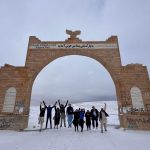
In a remote stretch of desert in Imperial County (Southern California), along a lonely highway, a sign rises from the sand announcing entry into a country that officially does not exist. Welcome to Slowjamastan – a whimsical yet surprisingly sophisticated experiment in sovereignty, imagination, and modern identity.
A Nation Born from Wanderlust
Slowjamastan was founded on 1st December 2021 by American radio personality Randy Williams, better known as “R Dub!”. Having achieved the rare feat of visiting all 193 United Nations member states, Williams found himself with nowhere left to go – so he created a new destination: his own country.
The spark came after a visit to the Republic of Molossia, one of the world’s best-known micronations. Inspired by its playful assertion of sovereignty, Williams returned home and quickly began laying the groundwork for his own state.
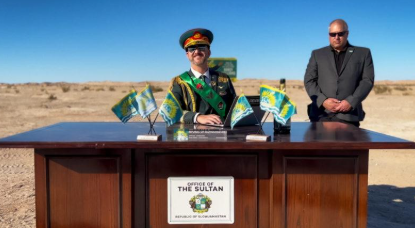
By October 2021, he had purchased approximately 11 acres of desert land along California State Route 78. Within weeks, he declared independence, crowned himself Sultan, and introduced the world to the “United Territories of the Sovereign Nation of the People’s Republic of Slowjamastan”.
What Is a Micronation?
Slowjamastan belongs to a curious global phenomenon known as micronations – self-declared states that mimic the trappings of real countries but lack formal recognition under international law.
These entities often exist as social experiments, artistic projects, or elaborate jokes – but many, including Slowjamastan, blend satire with genuine community-building.
Building a “Country” from Scratch
Despite its modest size – roughly 11 acres – Slowjamastan boasts many of the features of a conventional nation:
- A capital city, Dublândia
- A national currency, the ‘duble’
- A flag, anthem, and coat of arms
- A growing population of tens of thousands of registered “citizens” worldwide
The government is officially a dictatorship, though Williams humorously describes it as an “occasional democracy”, inviting input from citizens via on-line platforms. Listen to Slowjamastan’s National Anthem.
Its laws reflect the Sultan’s personal pet peeves – famously banning Crocs footwear, “mumble rap”, and even placing feet on a car dashboard.
Connections with Other Micronations
Far from existing in isolation, Slowjamastan is part of a lively global micronational community.
Williams has actively engaged in “diplomacy”, attending international gatherings such as MicroCon and meeting representatives from other micronations like Westarctica and Zaqistan.
In 2024, Slowjamastan even made headlines by appearing symbolically at a NATO summit, underscoring its tongue-in-cheek ambition to be taken seriously on the world stage.
These interactions highlight a key aspect of micronations: while not legally recognized, they often recognize each other, forming a parallel network of playful “international relations”.
Tourism in the World’s Most Unusual Country
Perhaps the most intriguing aspect of Slowjamastan is its emerging tourism appeal.
At present, the “nation” consists of:
- A roadside border sign
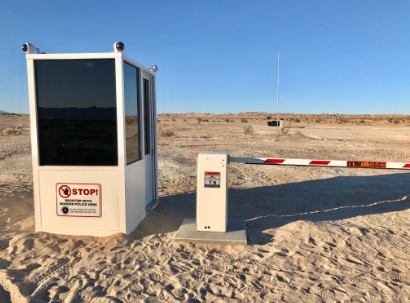
- A makeshift border control point
- An outdoor desk serving as the Sultan’s office
Yet this minimalism is part of its charm. Visitors can quite literally step out of their car and “enter” a country – an experience that blurs the line between performance art and travel.
Future plans suggest a more ambitious vision. Proposed attractions include:
- A bowling alley
- An armadillo petting zoo
- A hot dog emporium
- Even an artificial river in the desert
If realized, these developments could transform Slowjamastan into a quirky desert destination akin to roadside Americana – part theme park, part conceptual art installation.
The Meaning of Slowjamastan Today
As of the mid-2020s, Slowjamastan remains uninhabited, with its “population” existing largely on-line. Yet its influence extends far beyond its physical footprint.
It represents:
- A commentary on borders and nationhood
- A celebration of creativity in an increasingly regulated world
- A reminder that identity and belonging can be self-defined
What began as a personal project has evolved into a global curiosity – featured in media, attracting thousands of virtual citizens, and drawing real-world visitors to an otherwise empty patch of desert. Click on this link to apply for citizenship – as at April 2026, Slowjamastan have more than 25,000 citizens.
A Nation of Imagination
Slowjamastan may not appear on official maps, nor will its passport grant entry across borders. But in a world where travel is often constrained by geopolitics, it offers something rare: a place born entirely of imagination. Watch video of Slowjamastan.
In the end, its greatest achievement may not be sovereignty, but storytelling – a nation that exists because someone dared to ask: what if I could create my own world?
Difference between a Micronation and a Microstate
A Micronation is a political entity that claims to be an independent nation or sovereign state, but which lacks legal recognition by any sovereign state, often characterized by small size and a lack of international recognition. Micronations are self-proclaimed entities that assert their sovereignty as independent states, but are not recognized as such by any recognized sovereign state or supranational organization – examples being Principality of Hutt River, Republic of Uzupis, Liberland, Christiania, Conch Republic, Molossia, Talossa, Zaqistan, Ladonia and Atlantium. Micronations differ from Microstates which are internationally recognized as a sovereign state that is very small in area, population, and/or economic resources – commonly accepted examples include Andorra, Liechtenstein, Monaco, San Marino, and Vatican City. While small, Iceland, Malta, and Luxembourg are not typically considered Microstates because they have populations and land areas that surpass the size thresholds commonly used to define Microstates.
About Post Author