Nothing perhaps shows what a diverse, expansive and melting pot of a country this is than perhaps the varied languages of South Sudan. Officially at least the recognized languages of the state are English and Arabic, but there is much more to the story.
Travel throughout the country and there are at least 60 different languages, not to mention a whole heap of dialects, with many people particularly in the tribes only speaking their mother tongue.
Therefore despite the “officialness” of English and Arabic, to get by here it does not hurt to learn a bit of Dinka, Mundari, or whichever other place you might go.
Table of Contents
What the South Sudan?
South Sudan is the world’s youngest country, gaining independence from Sudan in 2011 after decades of brutal war. Before that it was part of Sudan, which itself had been stitched together by the British and Egyptians in a way that never really worked.
The north was largely Arab and Muslim, while the south was black African, Christian or animist, and very much not into being ruled from Khartoum. Two civil wars later and millions dead, the south finally broke away. Sadly independence did not bring peace, with internal fighting kicking off in 2013. Since then it has been a fragile state trying to hold itself together.
You can read about the conflict here.
South Sudanese languages and politics
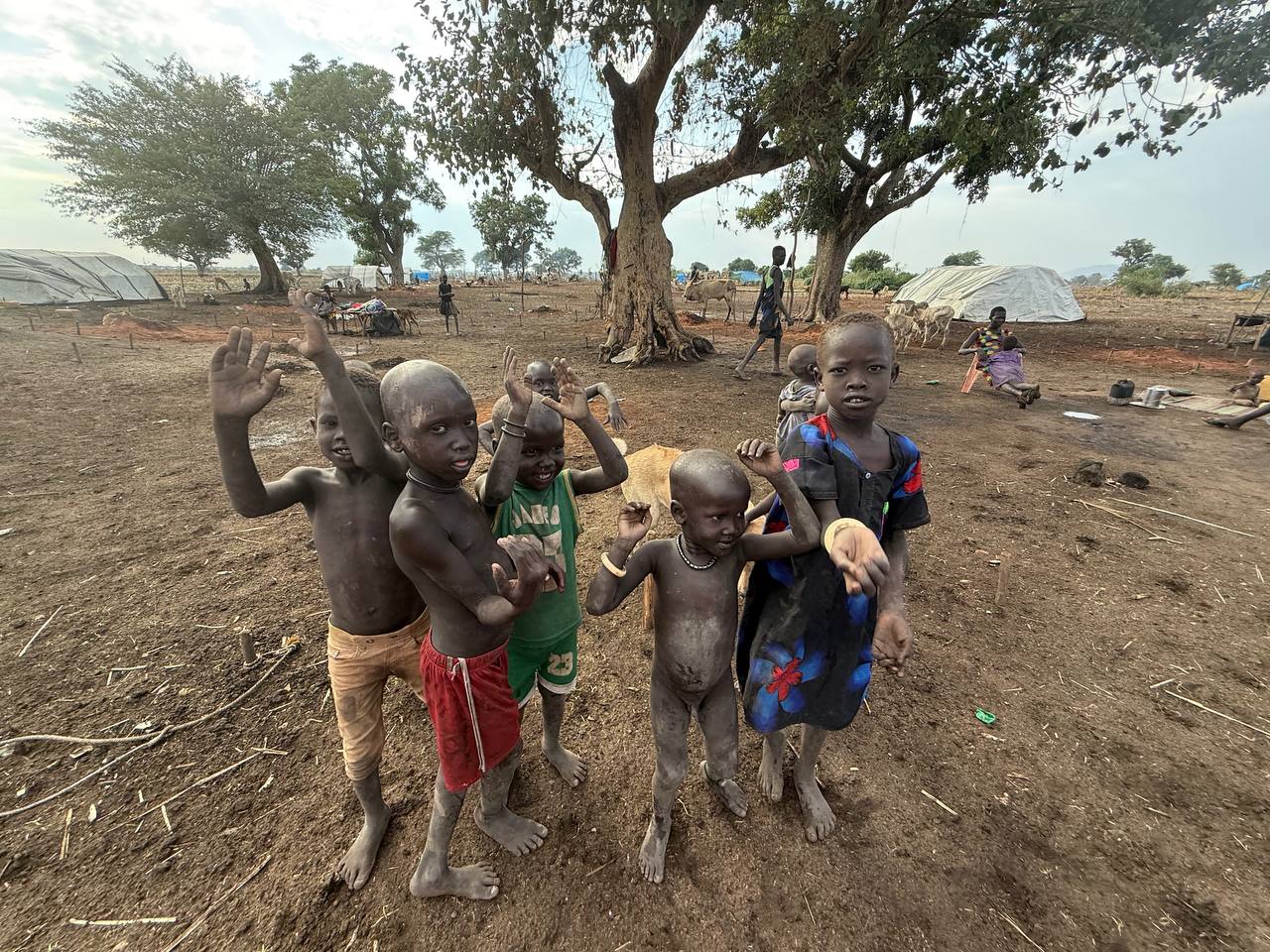
You cannot talk about South Sudan without talking about the Dinka and the Nuer. These are the two biggest ethnic groups and they dominate both politics and conflict. The Dinka are the largest group and their language, Dinka, is widely spoken across huge swathes of the country. President Salva Kiir is Dinka. The Nuer are the second biggest group, speaking Nuer, and historically pastoral rivals of the Dinka long before modern politics got involved.
The rivalry between the two is not just about cows and land anymore, it is deeply political. When the civil war broke out in 2013 it largely split along Dinka and Nuer lines, with Vice President Riek Machar, a Nuer, opposing Kiir. Language here is not just about communication, it is identity, tribe, and in many cases which side you are on. Speak the wrong one in the wrong place and you will notice it quickly.
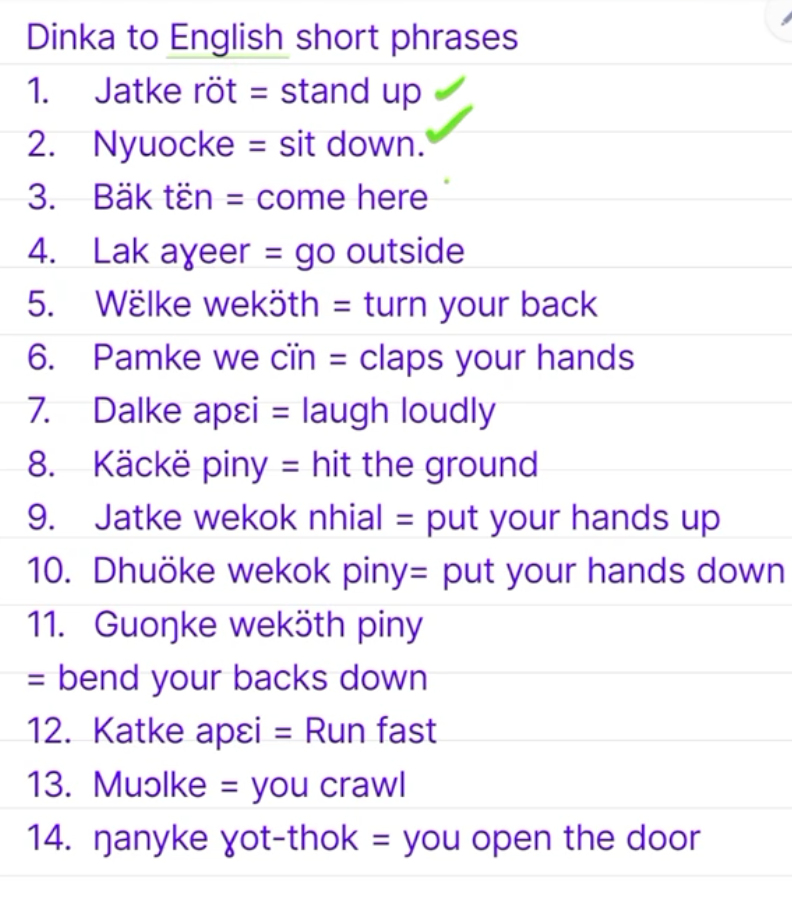
5 useful Dinka phrases
Hello – Malei
How are you – Yin ca ke
I am fine – An a lar
Thank you – Yin athin
Come here – Bï kɛ
5 Useful Nuer Phrases
Hello – Naath
How are you – Ke ci thin
I am fine – Ci thin
Thank you – Yin caa
Come – Ba
The 60 languages of South Sudan
South Sudan is one of the most linguistically diverse countries not just in Africa but anywhere. While many African countries have multiple languages, South Sudan takes it to another level with dozens of distinct tongues, many of which are not mutually intelligible. These languages fall broadly into Nilotic, Central Sudanic, and Ubangian families.
What makes it even more complex is that many are only spoken by relatively small groups, often in quite isolated areas. Compared to somewhere like Kenya or Uganda where a few major languages dominate, South Sudan feels like a patchwork where every few hundred kilometers you hit a completely different linguistic world.
List of the 60 languages of South Sudan
Dinka
Spoken by the largest ethnic group in the country and spread across much of central and northern South Sudan. It is not one single uniform language but a cluster of dialects that can sometimes be hard even for Dinka themselves to understand across regions. Deeply tied to cattle culture and identity.
Nuer
Second biggest language group, mainly in Upper Nile and Jonglei. Closely related to Dinka linguistically but politically and culturally very distinct. Widely spoken in rural areas with strong oral traditions.

Bari
Common around Juba and parts of Central Equatoria. One of the more accessible local languages if you are spending time in the capital region.
Zande
Dominant in Western Equatoria near the borders with Congo and Central African Republic. The Azande people have a strong cultural identity and history, and the language reflects that.
Shilluk
Spoken along the White Nile. Historically linked to the Shilluk Kingdom, one of the more organized pre colonial states in the region.
Mundari
Used by the Mundari people north of Juba. Known for their cattle camp culture, and their language is strongly tied to pastoral life.
Toposa
Found in Eastern Equatoria. A pastoralist group with linguistic links to other Nilotic peoples across the region.
Lotuko
Spoken in the hills of Eastern Equatoria. The Lotuko people are more settled agriculturally compared to some of the pastoral groups.
Acholi
Also spoken in northern Uganda, showing how colonial borders mean little linguistically. Found in southern South Sudan near the Ugandan border.
Lango
Another cross border language shared with Uganda, though much smaller presence inside South Sudan.
Didinga
Mountain based communities in Eastern Equatoria. Language reflects isolation with unique structures.
Boya
Also known as Larim. A small but distinct group in Eastern Equatoria.
Lokoya
A lesser known Eastern Equatoria language with a relatively small speaker base.
Lopit
Spoken by communities in the Lopit mountains. Strong local identity tied to geography.
Dongotono
A hill based language group with limited number of speakers.
Buya
Eastern Equatoria group, often interacting with neighboring pastoral communities.
Tenet
Small and quite isolated group, language not widely understood outside their community.
Murle
Spoken in Jonglei. The Murle are often in the news due to conflict issues, and their language is quite distinct from Dinka and Nuer.
Anyuak
Found along the Ethiopian border. Cross border ethnic group with strong ties into Ethiopia.
Madi
Common along the Uganda border. Another language that does not care much for colonial lines.
Kuku
Spoken around Yei. One of the more commonly encountered languages in that region.
Pojulu
Central Equatoria language with a decent number of speakers.
Avokaya
Western Equatoria language, part of the wider Central Sudanic family.
Baka
Forest based communities in Western Equatoria. Language reflects a more isolated lifestyle.
Bongo
Found in Western Bahr el Ghazal. Not to be confused with other Bongo groups elsewhere in Africa.
Bviri
Another Western Equatoria language with relatively small speaker numbers.
Fur
Originally from Darfur in Sudan but present due to migration. Shows how movement has shaped language spread.
Golo
Small community language with limited reach.
Indri
Minor Central Sudanic language, not widely spoken.
Jur Modo
Western Bahr el Ghazal language, part of the Jur cluster.
Jur Beli
Closely related to Jur Modo but still distinct enough to be considered separate.
Kara
Small Nilotic language group.
Kresh
A cluster language in western regions, with multiple dialects.
Kreish
Often used interchangeably with Kresh but can refer to specific dialects.
Lendu
More commonly associated with Congo, but present in border regions.
Logo
Central Sudanic language spoken in pockets of the country.
Lugbwara
Cross border group with Uganda and Congo.
Mangbetu
Another cross border group mainly from Congo but present in South Sudan.
Moru
One of the larger Western Equatoria languages with a strong regional presence.
Ngiti
Small Central Sudanic group.
Nyimang
Originally from the Nuba Mountains, present through migration.
Otoro
Another Nuba linked language found in smaller communities.
Päri
Located near Shilluk areas, showing linguistic overlap zones.
Reel
Western Bahr el Ghazal language with local importance.
Sere
Minor language with limited speakers.
Shatt
Also linked to Nuba regions, again showing migration patterns.
Tennet
Variant naming of Tenet, often used interchangeably depending on source.
Tira
Nuba origin language present through population movement.
Yulu
Western border language with small speaker base.
Zande dialects
Zande itself has multiple dialects that can vary significantly depending on location.
Beli
Related to Jur languages but distinct enough to stand alone.
Mittu
Small western group language.
Ndogo
Western Equatoria language with a defined ethnic base.
Ngolo
Minor group, not widely spoken.
Tagoi
Another Nuba linked migrant language.
Tocho
Very small and localized language group.
Uduk
Spoken near the Ethiopian border, another cross border linguistic group.
Kelo
Small language with very limited number of speakers.

English in South Sudan
On a day to day basis you can more than cope using English in South Sudan with the overall level being good. This is particularly the case with tour guides, hotels and doing business. There is though a very recognizable South Sudanese accent which can take some time to get used to.
This though changes rapidly when you get out of the big cities and particularly with tribes like the Mundari. Generally though if you get that far out you should have an interpreter with you.

South Sudanese Arabic
South Sudanese Arabic, often called Juba Arabic, is the real lingua franca of the country whether officials like it or not. It is not the same as the Arabic you will hear in Khartoum or Cairo. It is simplified, mixed with local languages, and very much a street language rather than something you will see written formally.
It developed during the years of Sudanese rule when soldiers, traders and different tribes needed a way to communicate. Today it is what taxi drivers, soldiers and market traders use. Even people who claim not to speak Arabic often understand it. If you learn one language here beyond English, this is probably the one that will actually get you out of trouble.
And that is our take on South Sudanese languages and how to cope when in country. If you’d like to learn more why not jump on a South Sudan Tour?
About Post Author