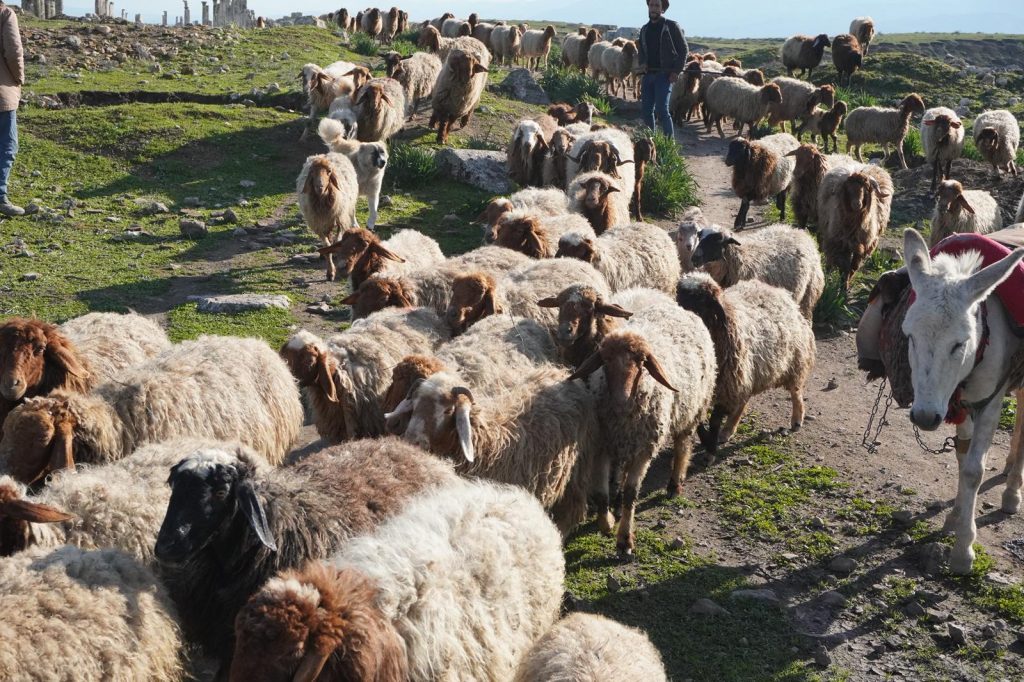
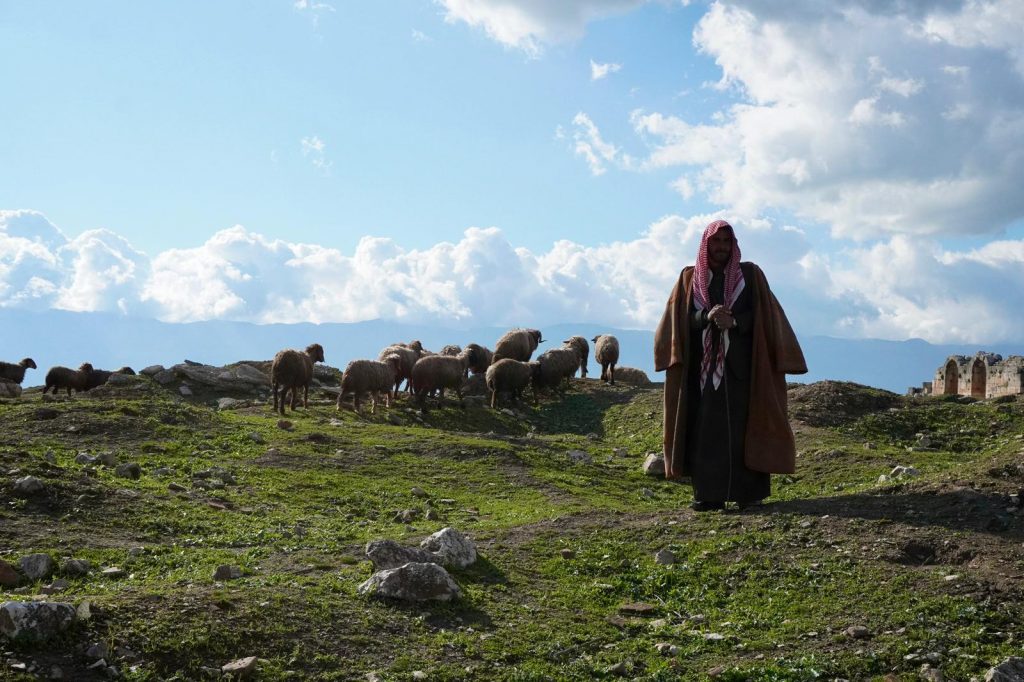
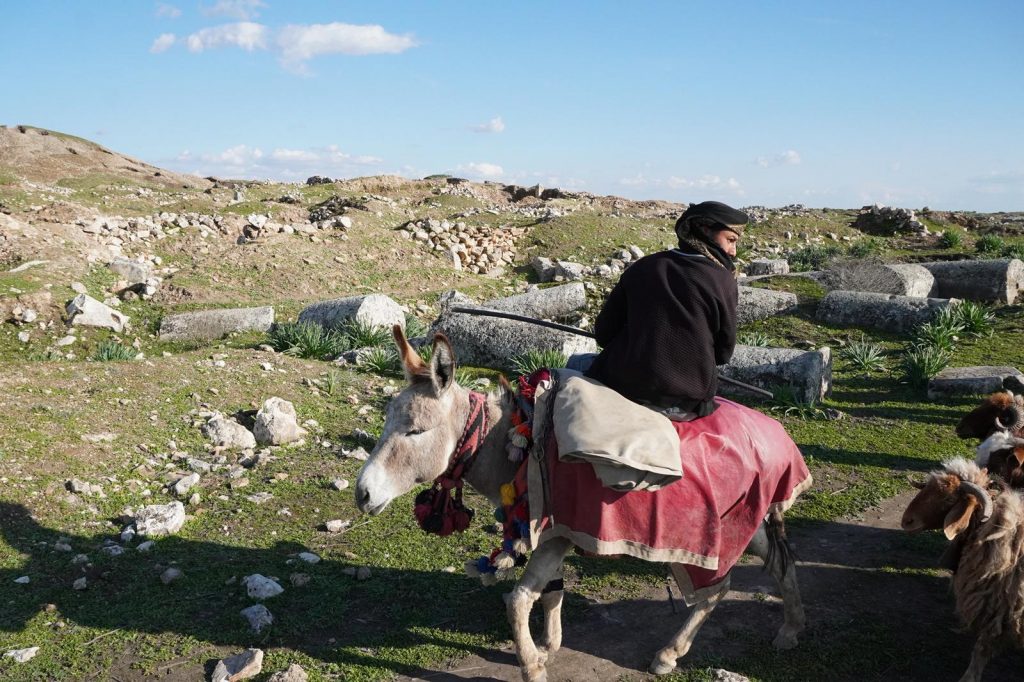
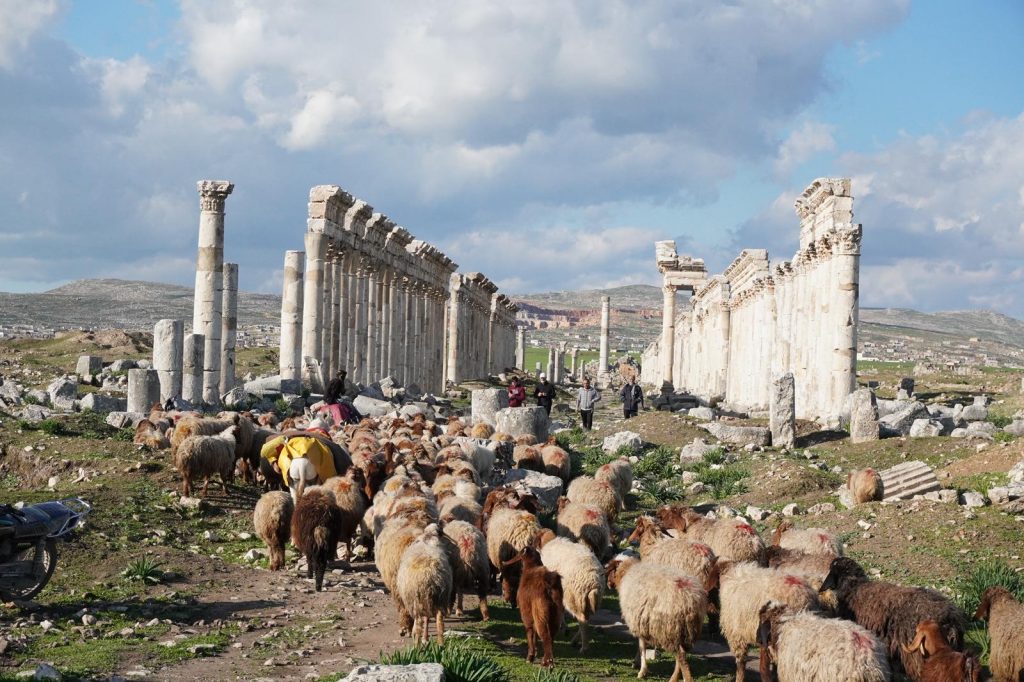
Apamea Syria is one of the most impressive Roman and Hellenistic sites in the world, however not many people know about the site, even many Syrians! On our group trips to Syria, we visit Apamea which is often completely empty or filled with sheep and local sheppards, clearly surprised to see people visiting, especially foreigners!
This article contains the history, importance and present day situation of the ruins of Apamea, a must visit site when visiting Syria!
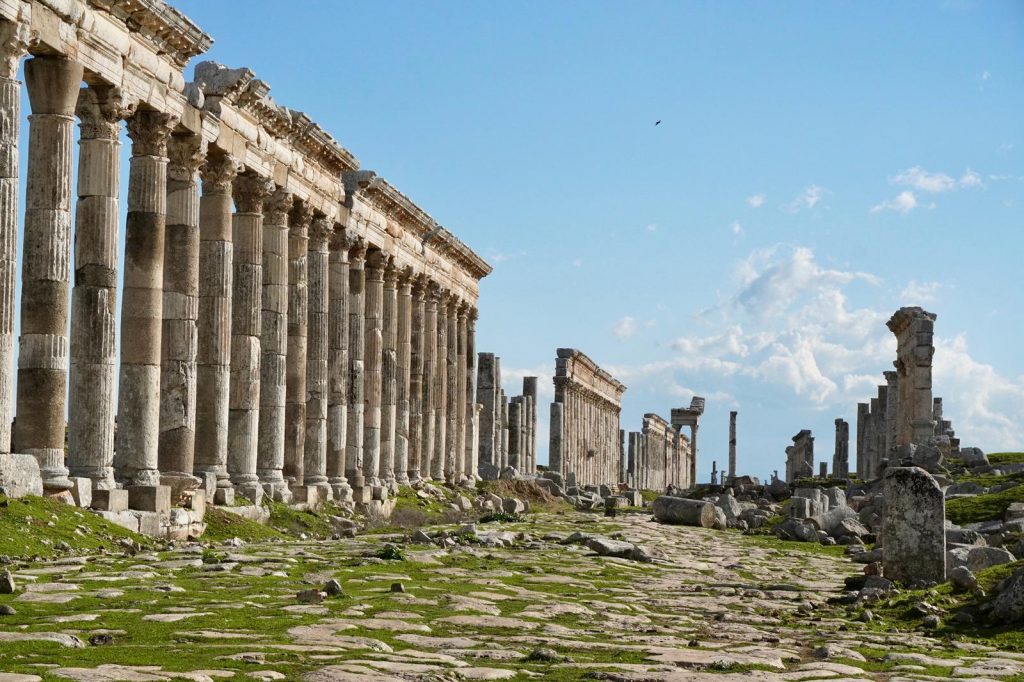
Table of Contents
The History of Apamea Syria
Apamea is located close to the Mediterranean sea in the North-Western side of the country, on the right bank of the Orontes River. The site is only approximately 60km from Hama city in the countryside.
Apamea is a Greek-Roman construction, however it also had influence from other civilisations including the Byzantines and during the Islamic period

Hellenistic era
After the conquests of Alexander the Great and the conflicts between his successors, the military settlement of Pella (later Apamea) was likely founded around 320 BC following the Treaty of Triparadeisos under Antipater, possibly inspired by Cassander. Around 300 BC, Seleucus I Nicator established it as the city of Apamea, naming it after his wife Apama. Located along the Orontes River, the city occupied a strategic trade crossroads and became one of the four cities of the Syrian Tetrapolis. It also served as a major military base with war elephants and large horse-breeding facilities. After 142 BC, the pretender Diodotus Tryphon used Apamea as his main base.
Early Roman period
In 64 BC, Pompey annexed the city to the Roman Republic and dismantled its fortress. During a later revolt led by Quintus Caecilius Bassus, the city resisted forces loyal to Julius Caesar for three years until the arrival of Cassius in 46 BC. During the First Jewish–Roman War, Apamea’s inhabitants protected their Jewish population from violence. The city was briefly captured in 40 BC by Pompeian and Parthian forces. A major earthquake in 115 AD caused significant destruction, though the city was later rebuilt.
Late Roman and Byzantine eras
From 218 to 234 AD, the Roman legion II Parthica was stationed in Apamea and later supported the rise of Elagabalus after the defeat of Macrinus in the Battle of Antioch. The city also appeared in Jewish religious texts and had connections to rabbinic Palestine. In the early 5th century, Apamea became the provincial capital of Syria Secunda. It was later destroyed by the Sasanian ruler Khosrow I during conflicts between the Byzantine Empire and the Sasanian Empire.
Islamic era
After the Muslim conquest of Syria following the Battle of Yarmouk, Apamea—known in Arabic as Afāmiya or Fāmiya—was partially rebuilt and used as a strategic observation point. Arab tribes such as Bahra and Udhra settled there. The city regained some importance under the Hamdanid dynasty of Aleppo. It was ruled by Khalaf ibn Mula’ib until 1106, when it was captured by Tancred after Khalaf’s assassination. A major earthquake in 1152 later destroyed much of the city.
Importance of Apamea
- 1. Strategic military center
Founded during the Seleucid period by Seleucus I Nicator, Apamea became a major military base of the Seleucid Empire. The city was famous for housing a huge military establishment, including hundreds of war elephants and large royal horse-breeding facilities, making it one of the key bases supporting Seleucid campaigns across the Near East.
- 2. Key city of the Syrian Tetrapolis
As mentioned, Apamea was located strategically near Antioch, Seleucia in Pieria, Apamea, and Laodicea (ad Mare). These four cities made up the Syrian Tetrapolis, famous for strong trading, military and economic powerhouses located in North-Western Syria and modern-day southern Turkey.
- 3. Major trade hub
Located along the Orontes River, Apamea sat on important trade routes linking the Mediterranean with inland Syria and Mesopotamia. This position allowed it to become a prosperous commercial city and a crossroads for merchants and travelers.
- 4. Important Roman provincial city
After the Roman annexation by Pompey in 64 BC, Apamea remained a large and wealthy city. Roman records indicate a very large population, and the city continued to function as an administrative and military center, unlike some other cities in the region.
Present Day Situation of Apamea, Syria
Today Apamea is in one of the more impoverished areas of the country. During the civil war, Apamea was located between the Opposition forces in the North-Western part of the country including the province of Idlib (these opposition forces partially make up the current government in Syria) and the government forces (now the former government) who controlled the rest of the land. When visiting, you would pass by numerous Russian military bases and hundreds of items of military equipment, which put people off visiting for many years.
However, now that the regime has changed, the area features less obstructions and visitors can visit the site without permissions. It is important to note however, that when walking you should stay on the colonnade street, as in many areas of Syria the full site has not been checked for explosives.
The site has not been fully excavated and many rocks remain in ruins around the site. The most incredible site to see is actually the Great Colonnade of Apamea which is 2km long making it one of the longest remaining Colonnade streets in the world!
Group tours To Apamea Syria
All our Syria group tours visit Apamea besides our Christmas tour which is a more express tour of the country. We have departures yearly in March, May, August, September and December. We can also organize a private tour for you to suit your dates, timeframe and budget!
About Post Author