Understanding a country’s currency is especially important when planning a trip. It helps you budget properly, handle daily expenses, and avoid unnecessary stress. In Angola, the official currency is the Angolan kwanza (AOA).
In this guide, you’ll find the practical information you need: how to exchange money, whether cards are widely accepted, and what to expect when paying for things. But we’ll also explore some background that won’t change how you pay for dinner, yet gives useful context about how Angola’s economy has evolved.
The kwanza is part of everyday life across Angola. Over the years, it has gone through major changes alongside the country’s independence, economic challenges, and recovery. Whether you are visiting or simply learning more about Angola, understanding the currency gives you a clearer picture of how the country works.
Table of Contents
History of Angola and the Angolan Currency
The story of the Kwanza is closely tied to Angola’s political and economic history.
Angola was a Portuguese colony for almost 500 years, from the late 15th century until independence in 1975. During that time, the country used the Angolan escudo, which was directly linked to Portugal’s financial system.
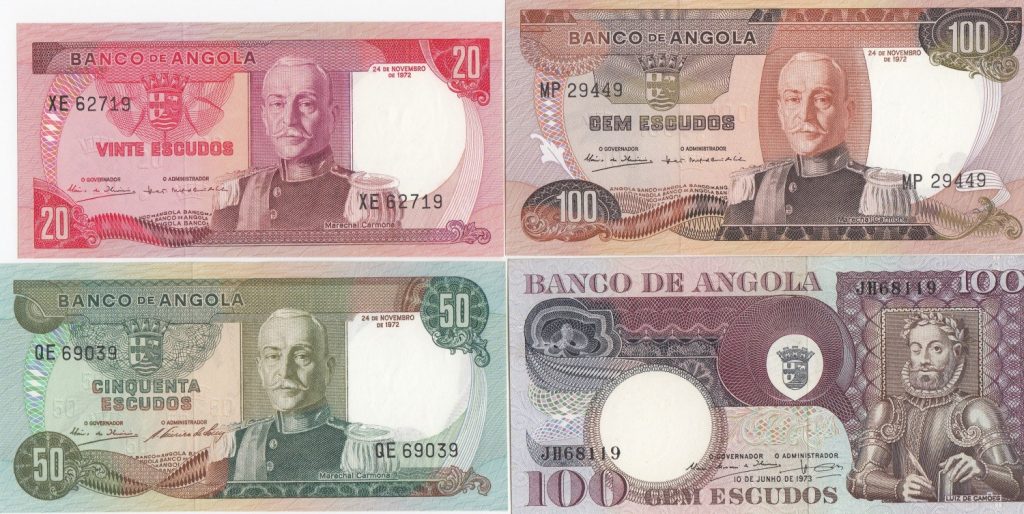
After independence in 1975, Angola introduced the Kwanza in 1977 as its official national currency. The name “kwanza” comes from the Kwanza River, one of the country’s most important rivers. Choosing this name was a deliberate statement of independence, marking a clear break from colonial history.
However, the country faced a long civil war and severe economic instability, which caused high inflation and reduced confidence in the currency. To address these challenges, Angola reformed its currency several times:
- Kwanza (1977–1990)
- Novo Kwanza (1990–1995)
- Kwanza Reajustado (1995–1999)
- Current Kwanza (1999–present)
Today, the kwanza is issued and managed by the National Bank of Angola, which oversees monetary policy and works to stabilize the currency.
Banknotes and Coins
For travellers in Angola, cash is the most common way to pay.
Banknotes
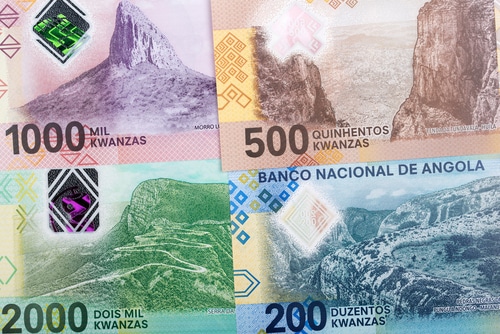
Angola’s current banknotes (issued from 2020) are colourful and distinctive. Every note features the face of António Agostinho Neto, the country’s first president, who led Angola to independence.
The most commonly used notes are 200 Kz, 500 Kz, 1,000 Kz, 2,000 Kz, and 5,000 Kz. These cover most everyday expenses, from small market purchases to meals and transport.
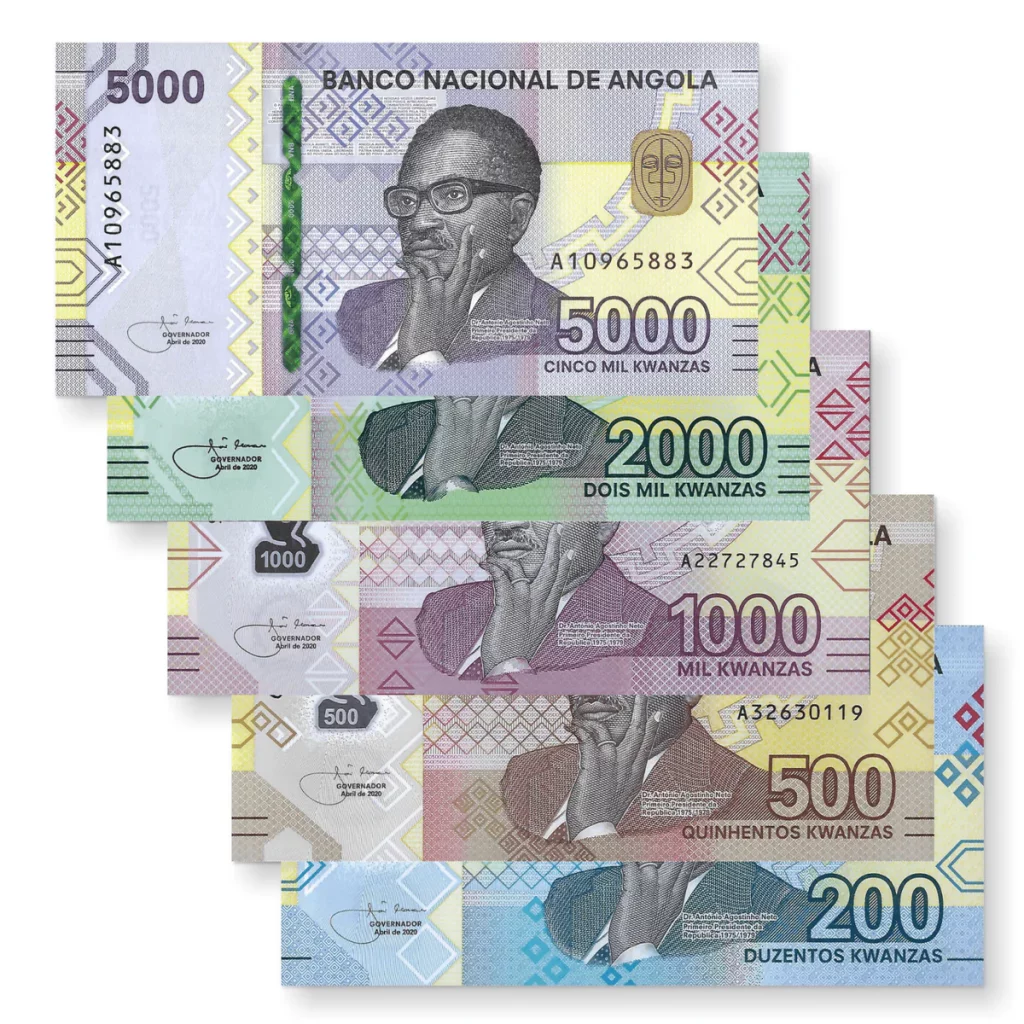
The notes also include security features such as watermarks, raised printing, and multicoloured designs to help distinguish denominations and protect against counterfeiting.
Coins
Coins are less commonly used than banknotes but are still handy for small purchases, buses, markets, and tipping. The most useful coins are 10 Kz, 20 Kz, 50 Kz, and 100 Kz, as smaller centimo coins are mostly phased out due to inflation.
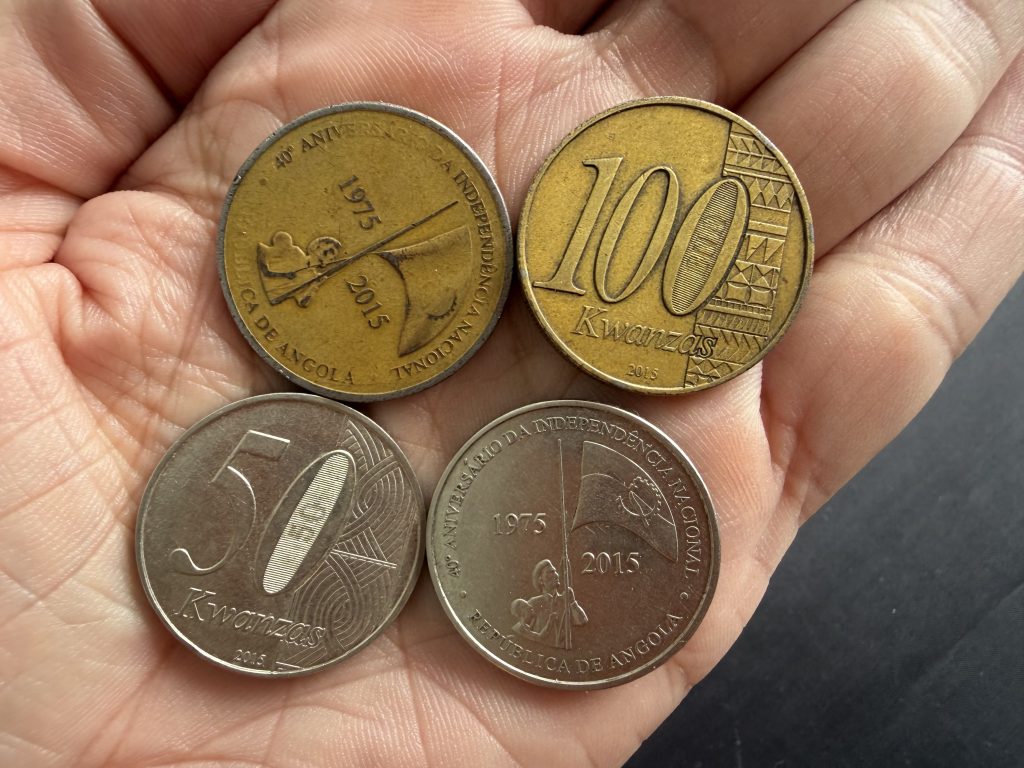
Current coins have the denomination on the front and, on the back, feature a figure holding a flagpole with the Angolan flag. Some older or commemorative coins depict historic figures like Queen Nzinga Mbande, a 17th-century ruler known for resisting Portuguese colonial forces.
Exchange Rate and Global Standing
As of early 2026, the kwanza’s value continues to be influenced by Angola’s economy and global markets.
Although the official rate is roughly 1 USD ≈ 825 AOA, in practice, travellers often exchange cash at around 1 USD ≈ 1,000 AOA, making it easier to estimate everyday expenses.
Some typical costs to give perspective:
- Local meal: around 7,000 AOA
- Western-style meal: around 25,000 AOA
- Beer: about 500 AOA in a supermarket and 1,500 AOA in a restaurant
- Bottle of water: roughly 200–400 AOA
Angola’s economy depends heavily on oil exports, with diamonds and agriculture also contributing. Fluctuations in oil prices can affect the value of the currency, but despite these swings, cash is reliable for day-to-day purchases.
How to Exchange Currency in Angola
If you’re heading to Angola, one thing to know right away is that exchanging kwanzas outside the country is extremely difficult. That means if you have any leftover cash at the end of your trip, it’s much better to swap it back into US dollars or euros before leaving.
When it comes to bringing money with you, stick to crisp, clean US dollar or euro notes. Worn or marked bills can be refused, so keep them in good shape. US dollars are generally the easiest to exchange, though euros work fine too as a backup.
Once you arrive, there are a few safe places to exchange your money. Banks are the most reliable, but they can have long lines and usually operate only on weekday mornings. Authorised exchange bureaux, often found in the city centre, are convenient, but check the rate before handing over your cash. Some larger hotels also exchange money, though the rate might not be as favourable as at a bank. Airport desks can get you cash immediately, but expect lower rates compared to city options.
Lastly, your local guide might be able to exchange some cash for you. And a quick tip: avoid street vendors, it’s risky, and counterfeit bills are common.
ATMs are another option, especially in bigger cities and at airports. Visa or Mastercard is far more likely to work than other cards. Daily ATM (Multicaixa) withdrawal limits are generally around 100,000–120,000 AOA, while per-transaction limits are often lower, around 40,000–60,000 AOA. ATMs can run out of cash or experience technical issues, so it’s highly recommended to carry some cash.
Finally, carry small denominations for taxis, markets, and tipping, and keep your passport handy; it’s often required for exchanges. Count your cash carefully before leaving the counter and hold onto the receipts just in case. Doing these little things makes handling money in Angola much easier and stress-free.
Acceptance of Cards in Angola
In Angola, cash remains the most reliable way to pay, especially for everyday expenses. Cards are accepted in larger hotels, upscale restaurants, and shopping centres, but these options are still limited compared to cash.
If you plan to use a card, Visa and Mastercard are the most widely accepted. Some places may take only one of these, and cards like American Express are rarely accepted. Higher-end restaurants, hotels, and car rental services often have terminals with chip-and-PIN security, and a few may even support contactless payments, but don’t count on it everywhere.
Travel tip: Keep some local currency on hand at all times. Even where cards are accepted, machines may not work or connections can fail, so having kwanzas ensures you can pay without any hassle.
Click here to check our Angola tours.
About Post Author