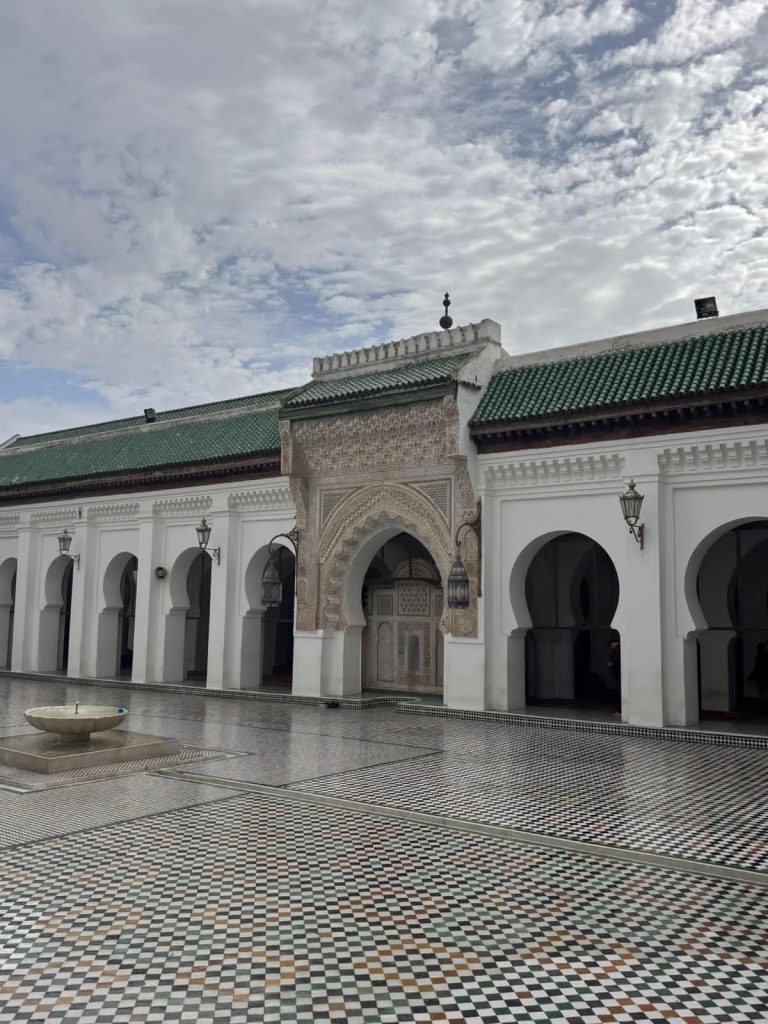
Located in the cramped old city of Fes, Morocco, a prominent madrassa and mosque complex is a focal point nestled between the bazaar stalls. Al-Qarawiyyin doubles as the world’s first university and an active mosque, established in 859 CE. In 2026, I was able to visit Al-Qarawiyyin, the world’s first university (and the oldest!).
Table of Contents
Fatima al-Fihri
Fatima al-Fihri was the daughter of a wealthy merchant who settled in Fes after moving from Kairouan in present-day Tunisia. When her father died in the 9th century, she inherited a large sum of money. This large sum of money was used to open the world’s first university. Yes, a muslim woman by the name of Fatima al-Fihri established the worlds first and oldest operating university.
In 859 CE, she used that inheritance to fund the construction of a mosque for the local community. The mosque became known as University of al-Qarawiyyin. Over time, it developed into a centre for religious and academic study, offering teaching in Islamic law, theology, Arabic grammar and other subjects.
Fatima’s sister, Maryam, is said to have founded the al-Andalus Mosque in Fes. This suggests the family was socially established and involved in the religious life of the city.
There is no extensive record of her education, daily life, or whether she had a formal scholarly role. What is clear is that she financed and oversaw the construction of a mosque that later developed into a major centre of learning.
University Studies
In its early centuries, teaching focused primarily on religious sciences. The core subject was Maliki Islamic law, which remains the dominant legal school in Morocco today. Students studied fiqh (jurisprudence), Qur’anic exegesis (tafsir), hadith (sayings of the Prophet), and theology. Mastery of Arabic grammar, rhetoric, and logic was essential, as these disciplines were necessary for interpreting religious texts accurately.
Beyond religious studies, Al-Qarawiyyin also became known for teaching mathematics, astronomy, medicine, and philosophy, particularly during the medieval period. Scholars connected to the wider intellectual networks of North Africa and Al-Andalus contributed to discussions that shaped Islamic thought for centuries. The institution operated through a traditional system in which students sat in study circles around a scholar and, after completing their studies, received an ‘ijazah’, a certification granting them authority to teach specific texts.
Ongoing Studies
In 1963, it was integrated into Morocco’s modern state education system. While it retained its historic identity, its curriculum was formalised and aligned with national academic standards.
Today, Al-Qarawiyyin continues to specialise mainly in Islamic and legal studies. Faculties focus on Sharia law, theology, Arabic language and literature, and Islamic history. It plays an important role in training religious scholars, judges, and imams within Morocco’s religious framework. The university also contributes to contemporary discussions around Islamic jurisprudence, ethics, and reform, engaging with modern legal and social issues through a traditional scholarly lens.
Design Of Al-Qarawiyyin
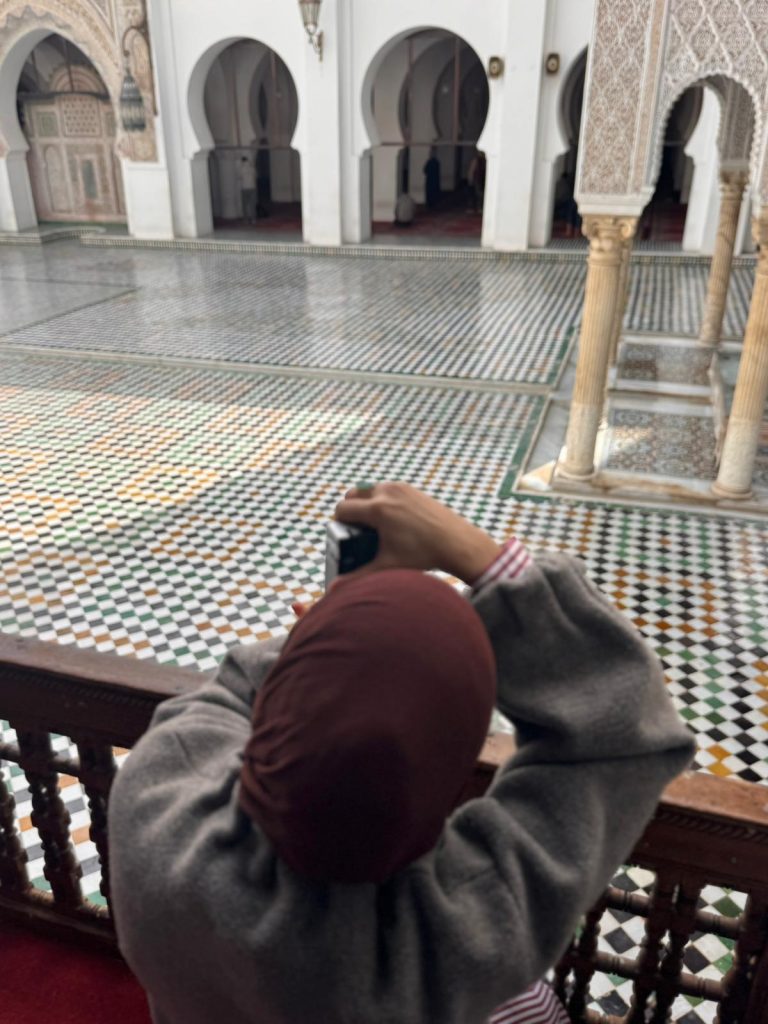
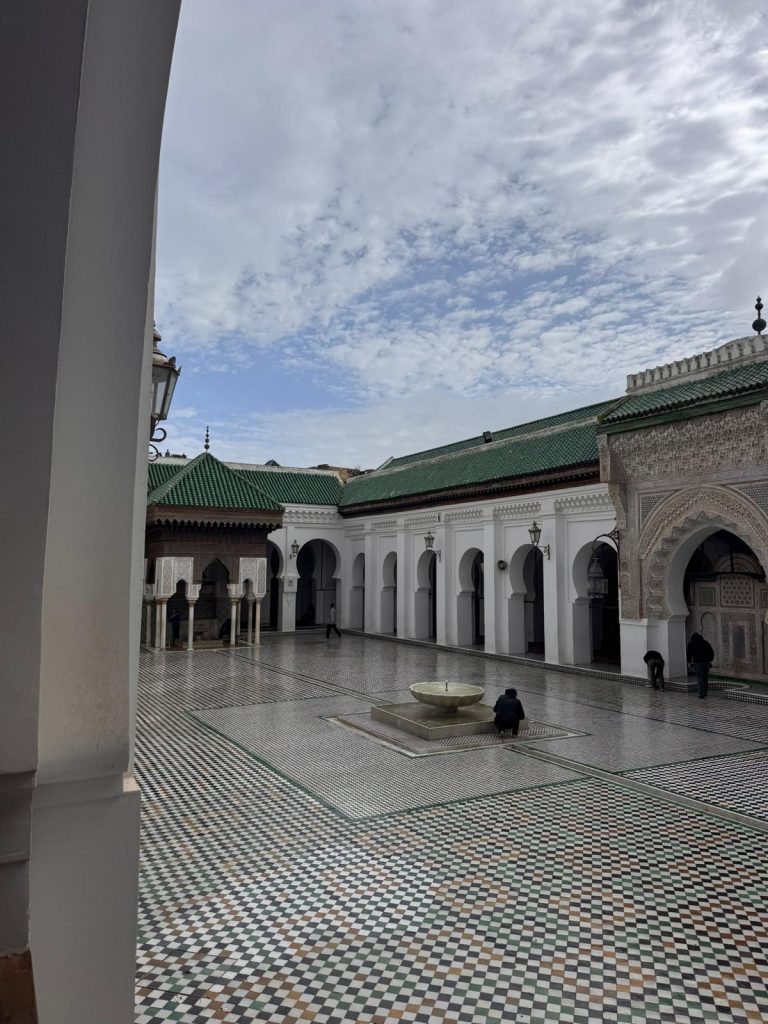
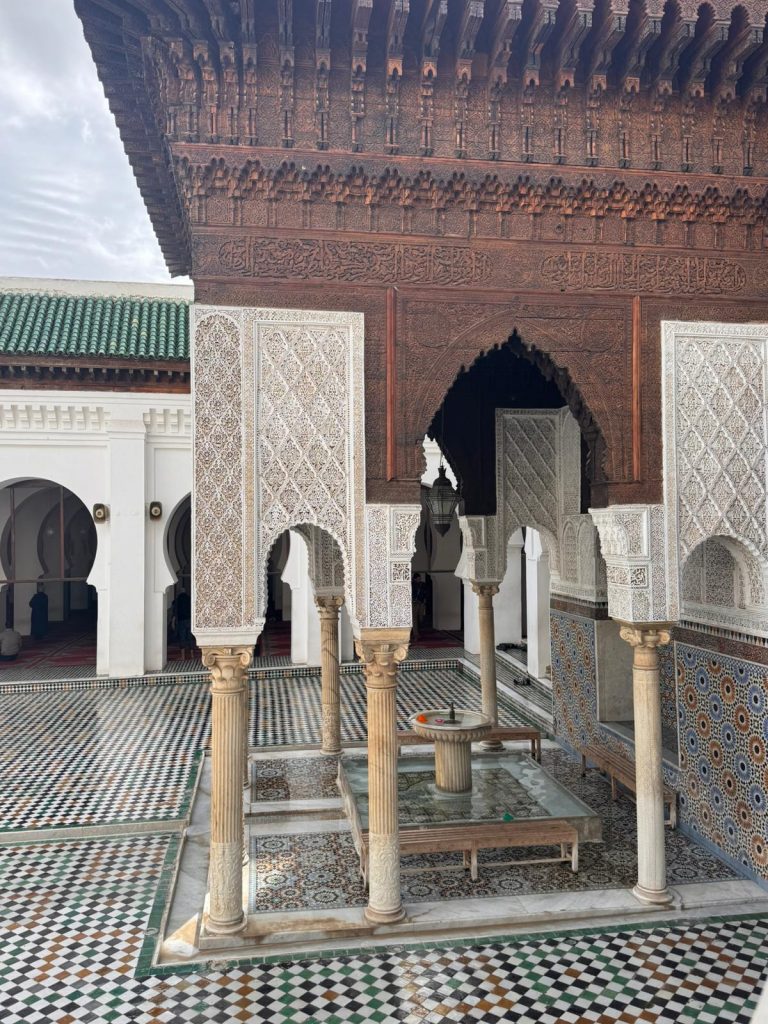
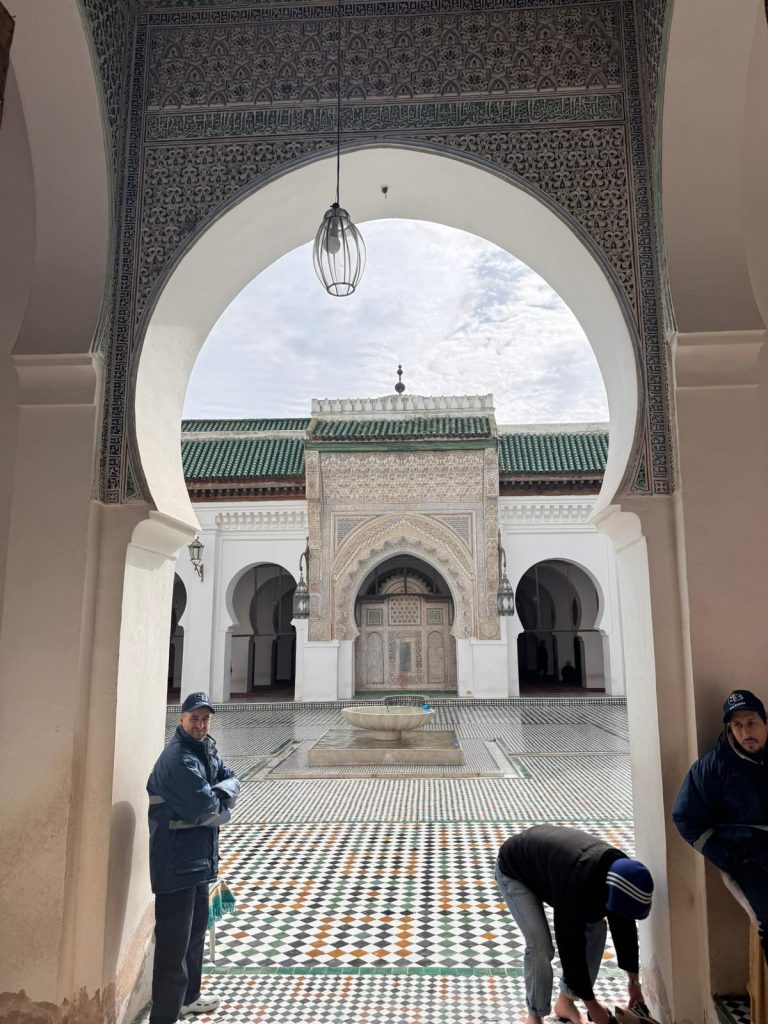
University of al-Qarawiyyin is designed around a traditional Moroccan mosque layout, expanded and refined over centuries. At its centre is a large rectangular courtyard (sahn) paved with marble and surrounded by arched galleries. A fountain sits in the middle for ablutions, reflecting the mosque’s religious function. The prayer hall extends from the courtyard and is supported by rows of horseshoe arches, creating a forest of columns that lead toward the mihrab, which indicates the direction of Mecca.
Much of the decoration of the world’s first university dates from later dynasties, especially the Almoravids and Marinids. Intricate zellij tilework, carved cedar wood ceilings, stucco plasterwork, and geometric patterns define the interior. The green-tiled pyramidal roof and square minaret are typical of Moroccan architecture. Over time, additions included multiple entrances, study areas, and one of the oldest surviving libraries in the Islamic world, blending religious, academic, and architectural heritage in one complex.
How You Can Visit
Non-muslims are not permitted to go inside the world’s first university, which is reserved for muslims and is opened around the time of each of the 5 daily prayers. There is a women’s wing which separates the main complex and allows privacy.
While non-muslims cannot go inside, you can visit the complex from the outside and take pictures from the doorway. From the doorway, you can view a majority of the courtyard.
Whether you are allowed to enter the world’s first university itself or not depends on your identity. Regardless, visiting Al-Qarawiyyin is a must do when visiting Morocco!
About Post Author