At Young Pioneer Tours it would be fair to say that we have more than a passing affiliation with all things Korean, and this of course includes the drink that is Soju!
Often erroneously compared with sake, vodka and even bai jiu, in fact it is not just an extremely varied drink in its own right, but also has importance of almost religious like manor for all Koreans.
So, what is soju? Who does it best and why do we say you should drink soju?
Table of Contents
What is Soju?
Soju is a clear distilled liquor traditionally made from rice, barley, or wheat, though modern commercial varieties frequently use sweet potatoes, tapioca, or other starches. Production begins with fermenting the chosen starch into a mash, which is then distilled into a clear, colourless spirit. Traditional soju was made in small copper or iron stills, but today industrial distillation dominates to ensure consistency across batches. Alcohol content in standard soju ranges from sixteen to twenty percent, with some small-batch or artisanal distillations slightly stronger.
Soju is subtle and slightly sweet, with a clean finish and minimal burn, making it versatile for sipping neat. It pairs perfectly with food, from grilled meats to stews, spicy dishes, and kimchi, and is widely consumed in all social settings in Korea. The production process, choice of starch, water quality, and distillation method all influence the flavour, giving soju remarkable variation despite its seemingly simple appearance.

Variations of Soju
Soju comes in many forms. Traditional soju is distilled from rice, barley, or wheat, but modern varieties often use sweet potatoes or tapioca. Alcohol content ranges from sixteen to twenty percent, though stronger artisanal batches exist. There are also flavoured sojus, with fruit, herbal, or ginseng infusions, which are popular in bars and restaurants.
Some sojus are distilled multiple times for higher purity, while others are diluted and sweetened for mass-market consistency. Small regional batches may have unique tastes based on the water and starch used. The differences in production, ingredients, distillation, and flavour make soju a highly varied drink, with subtle changes in sweetness, aroma, and alcohol strength depending on the maker and location.
North Korean vs South Korean Soju
The differences between North and South Korean soju are significant. North Korean soju is generally stronger on average, around twenty percent alcohol, and tends to be more natural in flavour with fewer additives, often giving it a rougher, earthier taste. South Korean soju, typified by Jinro, is usually around sixteen percent alcohol and smoother, processed for consistency, much like the difference between traditional kimchi and mass-produced kimchi.
Both countries also produce stronger or weaker variants outside these averages, but the general distinction is clear: North Korean soju prioritises natural ingredients and potency, South Korean soju prioritises smoothness and ease of drinking. The experience of drinking them differs, but both are essential to Korean liquor culture.
Click to read about North Korean cuisine.
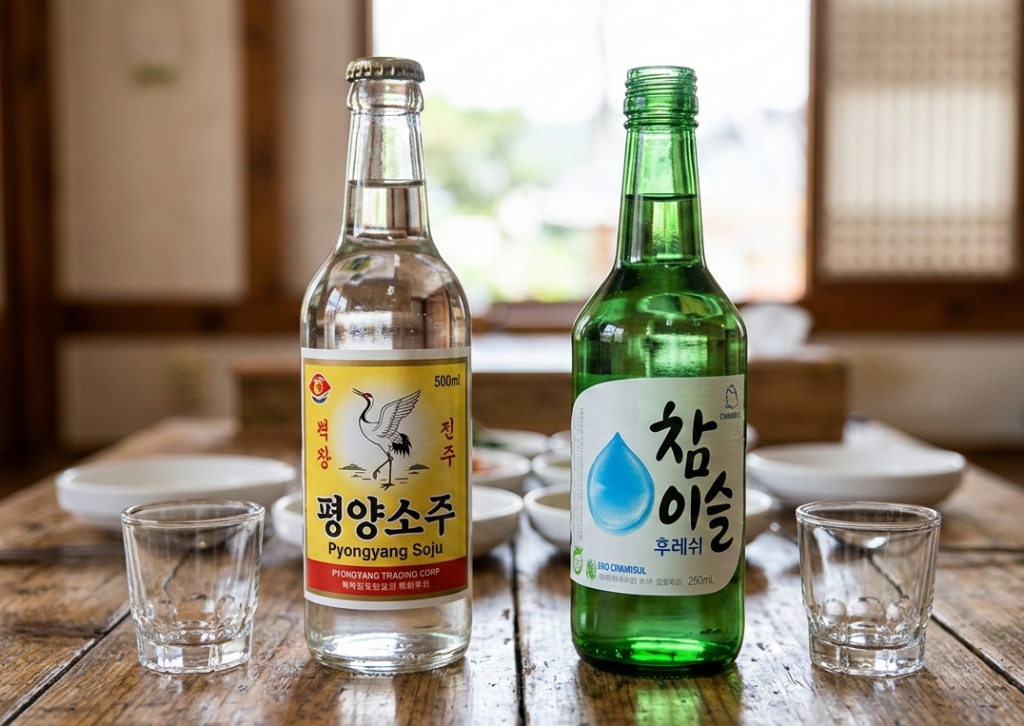
And Jinro?
Fun fact: Jinro is the biggest selling liquor brand in the entire world. Not just the biggest selling rice liquor, not just in Asia, but the biggest selling liquor full stop. Founded in 1924, Jinro dominates South Korea and exports worldwide. In 2024, Jinro sold over 80 million cases globally, equating to roughly 960 million litres. It is the liquor of choice in many Asian countries, including Cambodia, Thailand, and Vietnam, where bars and restaurants serve it widely.
Despite its scale, Jinro maintains traditional clear soju production while also offering lightly sweetened or flavoured variants for global markets. Its history, sheer volume, and international reach make Jinro a global phenomenon and cement soju as one of the most consumed spirits on the planet.

What is Soju tasting like?
Soju is without doubt an acquired taste, but most regular soju has a subtle, clean flavour. Unlike sake, it is generally easy to enjoy and pairs with a wide variety of dishes. In Soju versus Sake and Soju versus Bai Jiu, the former is the easier drink for most people. Unlike vodka it is not typically mixed. It is either sipped or, in my style, downed in one. F
lavoured sojus have grown popular but are not the standard. Smirnoff Soju, available in Thailand, is an exception and genuinely excellent. Traditional clear soju remains the benchmark for flavour and quality though, at least in our mind.

Drink Soju
With all of this in mind and everything considered, we are firm advocates for drinking soju in North Korea, South Korea, Yanji and beyond. It is versatile, potent, and culturally essential.
Of course, only in moderation….
Click to see our North Korea Tours.
About Post Author