It is thankfully not all that often that a flag can get you sent to prison, but in Indonesia at least there are a few that technically can. One of these is that of the Soviet Union, another is West Papua, while the last on the list is the Republic of South Maluku flag.
Why could a flag get you jailed? Well, because the relationship between Indonesians, or more specifically Javanese political power and the people of the Maluku Islands, is still complicated, emotional, and in places unresolved.
Table of Contents
The Republic of South Maluku Story
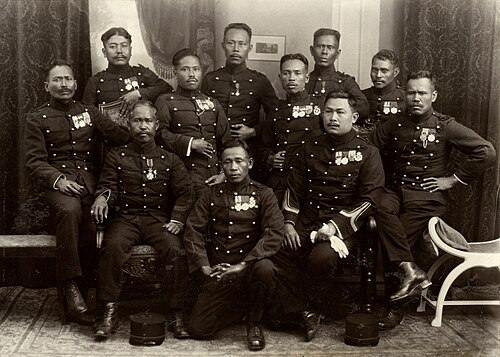
The Republic of South Maluku (RMS) was declared on 25 April 1950 in the Maluku Islands, shortly after Indonesia had gained independence from the Netherlands. The region, particularly Ambon, had been heavily integrated into the colonial structure and many of its local soldiers served in the KNIL (Royal Netherlands East Indies Army). When Indonesia became independent, fears grew among some groups in Maluku that the new central government in Jakarta would dominate local identity, politics, and religion.
In response, RMS declared independence as its own state. The Indonesian government under Sukarno rejected this immediately and launched a military operation to retake the region. By the end of 1950, the movement had been effectively crushed on the islands, and its leadership fled abroad, particularly to the Netherlands, where a government-in-exile still exists in symbolic form today.
While the armed movement ended quickly, the idea of RMS never fully disappeared. It has lived on through diaspora politics, cultural identity, and occasional flare-ups during unrest in Maluku, especially during the late 1990s and early 2000s communal conflicts in Ambon.
Click to read our full article on this.
The Republic of South Maluku Flag
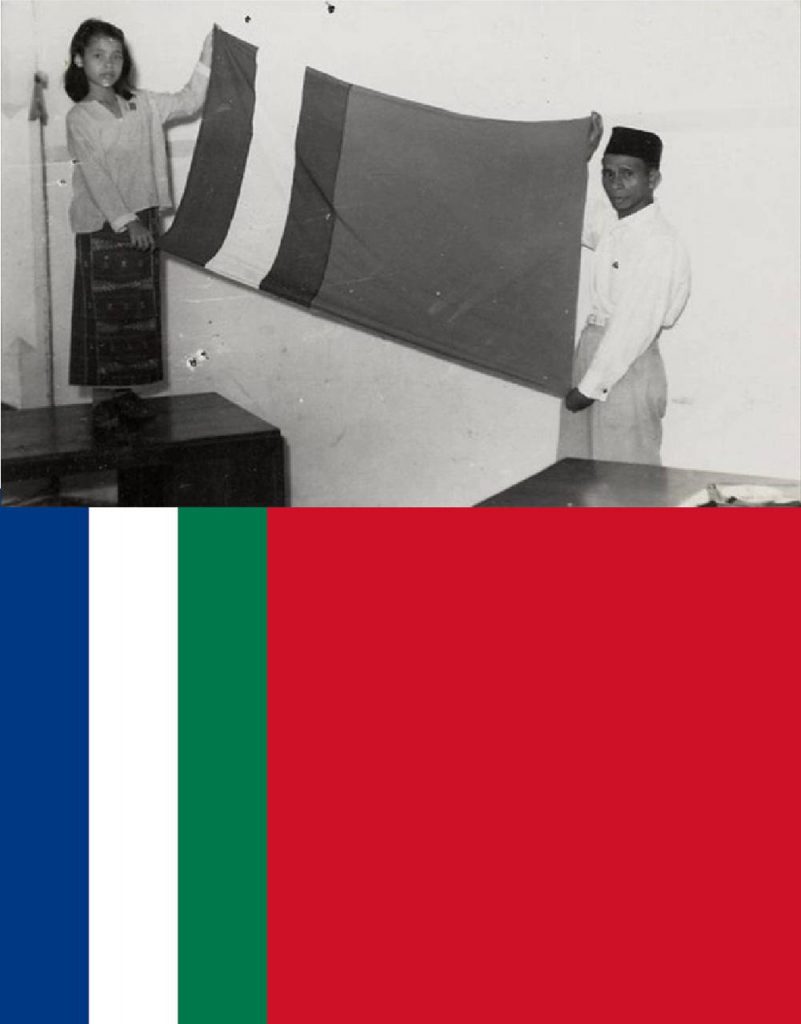
The RMS flag is one of the most politically sensitive symbols in modern Indonesia. It is simple in design but extremely loaded in meaning.
The flag is divided horizontally into two main colours. The upper half is blue, representing the sea that surrounds the Maluku Islands, a region defined by its maritime geography and island culture. The lower half is green, symbolising land, fertility, and the natural environment of the islands themselves.
Running vertically through the centre is a white stripe, which is generally interpreted as a symbol of peace, purity, and the desire for harmony. Overlaid on this is a red cross, which reflects the strong Christian identity of many of the original RMS supporters and leadership. This is important, as Maluku is religiously mixed, and identity politics between Christian and Muslim communities has historically played a role in regional tensions.
To supporters, the flag represents self determination, local identity, and resistance to centralised control from Jakarta. It is not just a political emblem but also a cultural one tied to exile communities in the Netherlands and memories of conflict and displacement.
To the Indonesian state, however, the flag is not viewed as cultural expression but as a separatist symbol. That distinction is key to understanding why it is treated so seriously in legal terms.
Can the South Maluku flag really land you in jail?
Technically yes, it can, and people have been arrested for displaying it in Indonesia, although enforcement today is less uniform than it was in the authoritarian New Order era.
The main legal framework used in these cases is the Indonesian Criminal Code (KUHP), particularly Articles 106 and 110, which relate to makar, or treason. Makar is broadly defined and includes any action interpreted as attempting to separate part of Indonesian territory or undermine state sovereignty. In practice, this has been used against a range of separatist symbols, including the RMS flag and the Morning Star flag in West Papua.
In addition, authorities may also use public order provisions when flags are displayed during protests or political gatherings, treating them as provocation or incitement rather than simple expression.
There have been multiple cases over the years of RMS flags being raised during demonstrations in Ambon and other parts of Maluku, with participants arrested and charged under makar provisions. Sentences have varied depending on context, intent, and political climate, ranging from short detentions to multi year prison terms in more serious or organised cases.
Since Indonesia’s democratic transition after the fall of Suharto in 1998, enforcement has become more inconsistent. There is now greater tolerance for regional identity and expression, but separatist symbolism remains a red line when it is seen as organised political activism rather than cultural remembrance.
So while displaying the RMS flag is not automatically a guaranteed prison sentence, it remains legally risky inside Indonesia, and in certain contexts it can still very much lead to arrest and prosecution.
We did not currently offer group tours to Maluku, but we can offer bespoke trips, as well as to West Papua.
About Post Author