Hidden away for decades and once dismissed by Western intelligence as little more than a radar anomaly, the Caspian Sea Monster remains one of the most bizarre and fascinating military experiments of the Cold War. Officially known as the KM (Korabl-Makèt, or Ship Prototype), this colossal machine blurred the line between aircraft and ship and represented the Soviet Union’s bold attempt to rethink naval warfare entirely.
Today, the remains of this once top secret project sits quietly along the shores of the Caspian Sea, where travellers can see it up close. A relic of a time when size, secrecy, and experimentation ruled supreme.
Table of Contents
Why Was the Caspian Sea Monster Created?
The Caspian Sea Monster was born out of Cold War necessity and Soviet ingenuity. During the 1950s and 1960s, the Soviet military sought ways to move troops, missiles, and heavy equipment rapidly while avoiding detection by NATO and US radar systems.
The solution was the Ekranoplan. A vehicle designed to fly just a few meters above the surface of the water using ground effect, a phenomenon where lift increases and drag decreases when flying close to a surface. The KM was the most ambitious of these designs. Nearly 100 meters long, weighing over 500 tons, and powered by ten.. that’s right, TEN jet engines.
Unlike conventional aircraft, it could not climb to high altitude. Unlike ships, it was fast, capable of reaching speeds of over 500 km/h. This made it ideal, in theory, for surprise attacks, rapid troop deployment, and missile delivery, all while staying beneath enemy radar coverage.
What Were the Advantages of the Caspian Sea Monster?
The Caspian Sea Monster offered several strategic advantages. The most important being Radar evasion. Flying just above the water kept it below most early warning radar systems at the time. It was muchfaster than any conventional naval vessel. The payload capacity was tremendous being able to carry heavy military equipment, vehicles, or missiles. And one that was not considered important at the time but fuel efficiency. Ground effect flights uses less fuel than traditional aircraft of similar size.
In essence, it was designed to combine the best qualities of ships and aircraft without fully being either.
However, these advantages came with drawbacks. The KM was difficult to control, vulnerable to rough seas, and incredibly expensive to maintain. After a crash in 1980 and changing military priorities, the program was quietly shelved.
Why Test It in the Caspian Sea?
The Caspian Sea was the perfect testing ground for the Soviets. As the world’s largest enclosed body of water, which theoretically shouldn’t be called a sea, but it offered vast open space without the political complications of international waters. Crucially, the Caspian was entirely under Soviet control at the time, allowing secret testing far from prying eyes.
Its relatively calm waters also made it ideal for experimenting with massive ground effect vehicles that required stable conditions. Testing primarily took place near the coast of what is now the Republic Dagestan, a region that played a quiet but significant role in Soviet military research.
For years, Western analysts observing satellite images were baffled by what they saw. Unsure whether the Caspian Sea Monster was a ship, a plane, or something else entirely.
Where Can You See the Caspian Sea Monster Today?
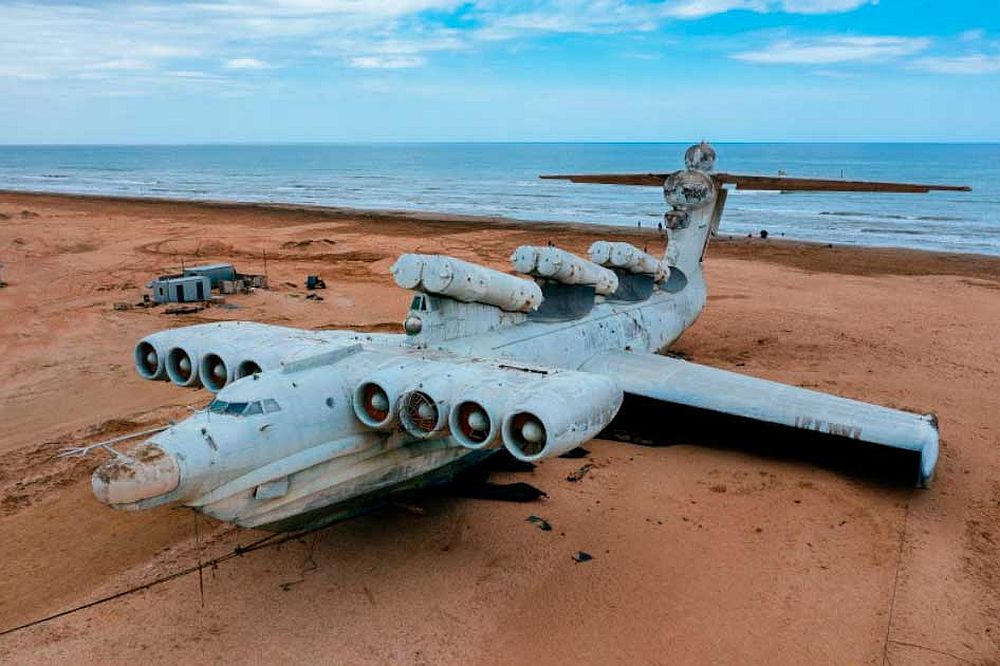
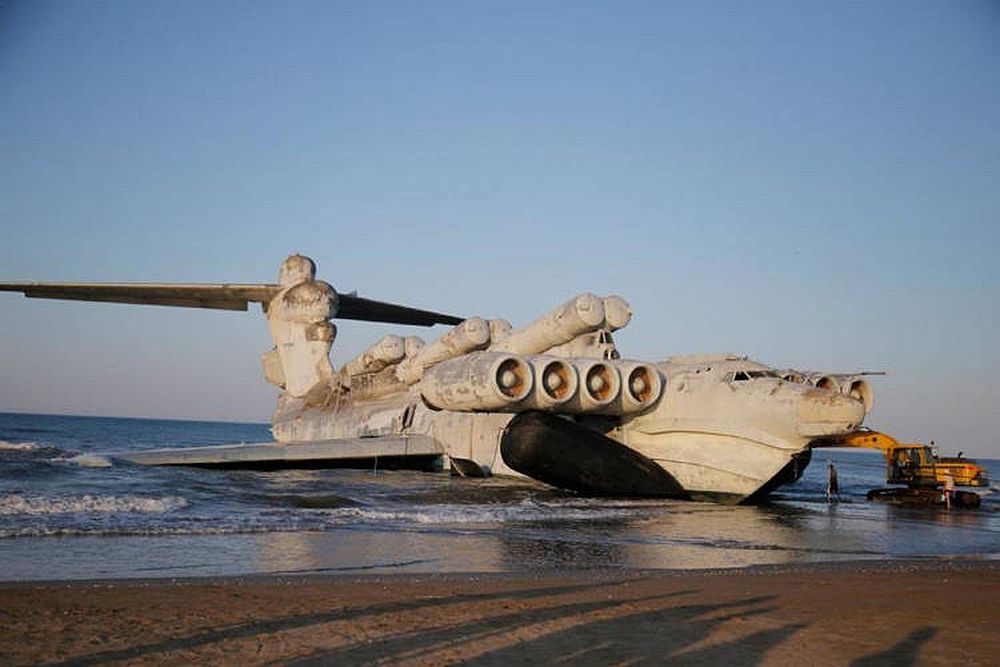
While the original KM prototype no longer exists, its successor, the Lun-class ekranoplan still remains.
This enormous machine rests on the shores near Derbent, partially beached and slowly being reclaimed by the elements. Towering, rusting, and unmistakably otherworldly, it has become one of the most surreal Cold War relics still accessible to the public.
Standing beside it, the sheer scale becomes apparent that this beast was never just a prototype. It was a genuine attempt to redefine warfare.
Visiting the Caspian Sea Monster with Young Pioneer Tours
The Caspian Sea Monster isn’t located behind museum glass or polished for mass tourism. Reaching it requires travel to one of Russia’s least visited republics, navigating the fringes of the Caucasus and the Caspian coastline.
This is exactly the kind of experience Young Pioneer Tours specialises in.
On our Dagestan tours, we visit the Lun-class ekranoplan as part of a broader journey through a region defined by dramatic landscapes, layered history, and cultures rarely seen by outsiders. From ancient fortresses and mountain villages to Soviet relics and Caspian Sea sunsets, Dagestan offers a glimpse into a side of Russia few ever experience.
Seeing the Caspian Sea Monster in person isn’t just about military history, it’s about standing face to face with one of the boldest and strangest ideas the Cold War ever produced.
About Post Author