At Young Pioneer Tours we end up in a lot of strange and wonderful places, but few things stick in your head quite like the first moment you see the Bolivia flag fluttering in the breeze high up in the Andes. You are on a windy plaza in La Paz or marching up the road to Uyuni and there it is, bright red, yellow and green, flapping like it owns the place. It feels unapologetically bold, and by the time you have spent a few days in Bolivia you will realise the Bolivian flag is not just a piece of cloth. It is a symbol, a story, and a reminder that no matter how weird the altitude makes your head feel, you are somewhere seriously unique.
Everyone talks about Uyuni Salt Flats or the death-defying roads, but the first cultural marker you see almost everywhere is the Bolivia flag. You will find it sewn onto backpacks, painted on walls in Potosí, stitched into hats in Sucre, waving outside government buildings in Cochabamba, and flying defiantly over tiny pueblos deep in the altiplano where barely a soul aside from locals and criollo livestock pass by.
Table of Contents
What the Bolivian Flag Looks Like
The Bolivia flag is deceptively simple at first glance with three horizontal bands of red, yellow and green. But like most national symbols, it is loaded with meaning if you bother to look properly. Red represents the bloodshed of those who fought for independence. Yellow stands for the wealth and mineral riches that have shaped Bolivia’s history and in cities like Potosí that mining legacy is everywhere. Green is for the fertility of the land and hope for the future.
Then there is the coat of arms, the emblem right in the centre of the yellow band when you are looking at the Bolivia flag in its official capacity. That miniature story of Bolivian identity features llamas, mountains, trees, nine stars and muskets, encapsulating a tale of resilience and diversity that you will encounter everywhere once you set foot in the country.

Why You See the Bolivian Flag Everywhere
Bolivia is a country of contrasts and contradictions. The moment you step outside your hotel in La Paz, you might see a luxury car next to a heap of market stalls selling llama wool and dried corn. And everywhere you look is the Bolivian flag, as if to remind you that Bolivia does not apologise for being exactly what it is.
On national holidays the whole place turns into one big flag parade. Streets get draped in red, yellow and green, school kids march in immaculate uniforms, and even the smallest barber shop will have its own tiny Bolivia flag stuck in the window. You do not need to know the national anthem to feel pride when you see the flag. You feel it in the street art, in roadside coca leaf offerings, in the riot of colours at markets like Tarabuco. The flag tells you you are somewhere that took centuries to carve its place out of rugged mountains and dense jungle.

The Flag and Indigenous Identity
The best thing about Bolivia is you do not have to wander far before you find another symbol flying alongside the Bolivia flag, the Wiphala. It is a patchwork rainbow square made of diagonal blocks that represent Andean indigenous communities, especially the Aymara and Quechua, and it is every bit as official as the three-stripe flag in many parts of the country.
Seeing the Bolivian flag and the Wiphala side by side is a crash course in Bolivia’s soul. The government buildings in La Paz and Sucre often fly them together. On market days you will see them stitched into belts, beanies and bags. Locals will tell you without winching that they stand for unity and heritage. In a country where indigenous people make up a big portion of the population, you come to realise that the Bolivian flag is not just a relic from colonial times. It is something that is evolving with the people.
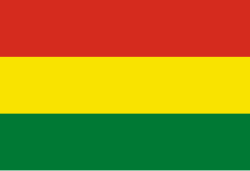
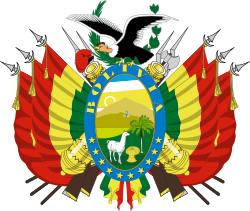
Photo of the Fla and Coat of arms
What It Feels Like to See the Flag in the Wild
You can read the meaning of colours in a book but until you are stood on the Avenue of Heroes in La Paz with the wind howling and the Bolivia flag snapping at full tilt it does not quite land. In Sucre you see the flag over whitewashed colonial buildings under impossibly blue skies. In the highlands the flags stand guard outside tiny churches where the townfolk gather for Sunday mass. Even at four in the morning when you are queuing for a bus to Salar de Uyuni you will see the tricolour tracing ghosts against the stars.
In Bolivia nothing feels ordinary and the Bolivia flag mirrors that. It is proud without pretence, colourful without being cheeky and like the country itself impossible to ignore.
Final Word
So if you are heading off with us to Bolivia or thinking about it, keep your eyes peeled for the flags. They are everywhere for a reason. They tell you where you are, who the people are, what they have fought for and what they hope for next. And that is worth more than all the altitude headaches and bizarre bus routes combined.
Click to see our Americas Tours.
About Post Author