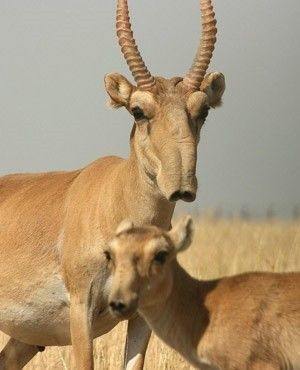
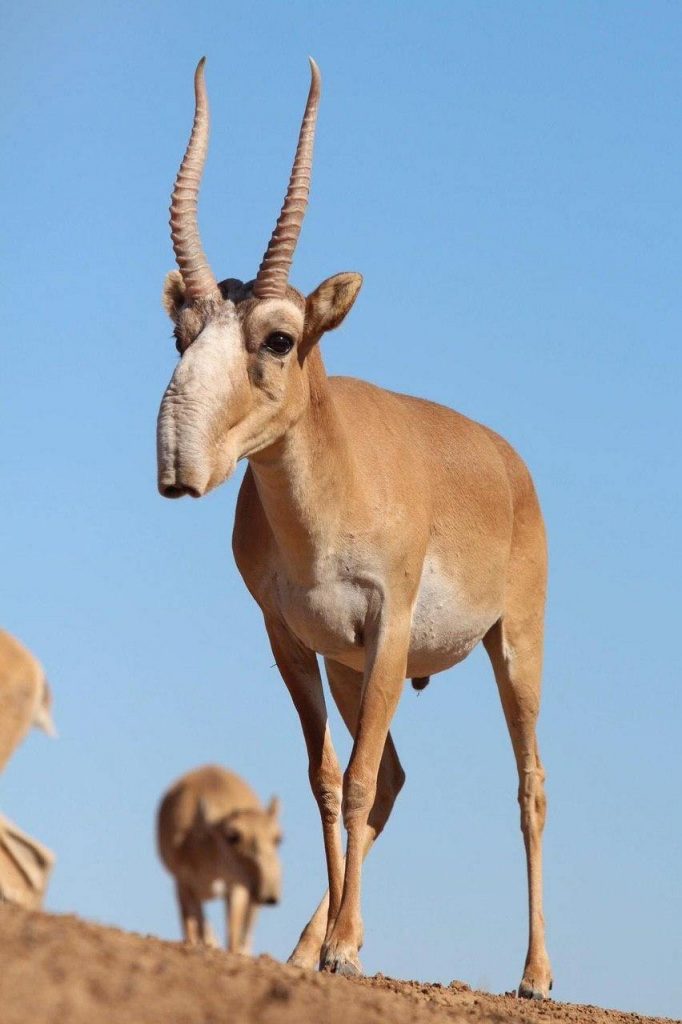
The saiga is the kind of animal that makes you do a double take. Technically an anteploe, it’s not sleek, it’s not elegant, and it certainly doesn’t look smart. Its defining feature is that oversized, droopy nose, which looks like evolution had a sense of humour. Some people call it unique; others call it ridiculous. Its body is short, legs are thin, coat sandy beige in summer and pale in winter, and males have curved, ridged horns that are more ornamental than threatening.
Despite appearances, and evolution, the saiga has managed to survive in harsh Central Asian climates where few other animals could. It wanders across Kazakhstan, Uzbekistan, Turkmenistan, Mongolia, and parts of Russia, often moving in herds that seem more confused than coordinated, yet somehow enduring for centuries.
Click to see our article in Animals of Central Asia.
Table of Contents
Habitat and Range
Saiga prefer open plains and semi-desert areas. Herds can number from a few dozen to several hundred, which is both their protection and their vulnerability. Following each other blindly works against them when disease strikes or predators are nearby. Migrations are a spectacle of chaos: thousands of slightly awkward animals, all moving in roughly the same direction, sometimes running into one another, sometimes treading over rough terrain without much sense. They can reach speeds of up to 80 km/h, which is impressive, though the herd doesn’t always behave intelligently enough to use that speed wisely.
They are remarkably resilient to temperature extremes. Winters can plunge to minus 40 degrees Celsius, summers rise above 35 degrees, and the saiga keeps going. Human activity has been far more dangerous than natural predators. Poaching for their horns, which are used in traditional Chinese medicine, has decimated populations. In the 1990s, numbers fell from over a million to tens of thousands in some areas. Disease outbreaks such as pasteurellosis can kill thousands in a single season because the herd follows each other almost blindly.
Appearance and Behaviour
The saiga’s nose isn’t just funny-looking; it’s practical. It filters dust during migrations and warms cold air in winter. Adults weigh between 26 and 63 kilograms, about the size of a medium dog, but with a long, oddly shaped face. Males have curved horns used during the rut, though fights are more about stamina than cunning. Females give birth to one or two calves after about five months of gestation. The calves are surprisingly agile, able to keep up with the herd almost immediately, which is probably the only thing about them that shows any cleverness.
Herd behavior can look chaotic. Saiga move in close groups, often bumping into each other, following one another blindly across vast plains. This strategy works for spotting predators, but it can also make them vulnerable to accidents and disease. The herd instinct is stronger than intelligence, yet it keeps them alive, which is remarkable in itself.
Diet and Survival
Saiga are herbivores. They graze on grasses, herbs, and shrubs depending on the season, wandering constantly in search of food. Their metabolism is high, which fuels long migrations, but it also means they need to keep moving. They survive in some of the most extreme temperatures on Earth, a testament to endurance rather than sophistication. Predators include wolves, but humans have historically posed a far greater threat. Poaching and habitat destruction have caused dramatic population declines. Conservation programs in Kazakhstan, Russia, and Mongolia now attempt to protect remaining herds, but the saiga is still critically endangered in some regions.
Has The Saiga leant its name to anything?
The saiga has not exactly become a household brand but it has lent its name in a few places. Several scientific projects, wildlife reserves, and research programs in Central Asia use saiga in their titles to signal a focus on steppe conservation. Some zoos and educational campaigns have adopted the name for exhibits or awareness drives.
Beyond that it has not spawned products, drinks, or games. Mostly its name exists in biology papers, conservation projects, and a handful of nature documentaries, keeping the legacy alive. Internationally there is also Saiga Tours, who are based in the region.
Does the Saiga Matters?
Even if it’s ungainly, slightly ridiculous, and not the sharpest animal in the steppe, the saiga is a crucial part of Central Asia’s ecosystems. It’s an indicator of steppe health and survival. Observing a herd is simultaneously funny, odd, and impressive. Their bizarre features, herd dynamics, and ability to endure extreme climates make them living relics of an ancient landscape. They may not be elegant or clever, but they persist where others fail.
The saiga is awkward, slightly absurd, and not particularly bright, but it’s one of Central Asia’s most fascinating creatures. It survives in extreme conditions, stubbornly enduring poachers, disease, and harsh winters. For anyone wandering the steppe, seeing a saiga herd is a strange, humbling experience—partly amusing, partly awe-inspiring. They are living proof that survival sometimes rewards persistence over grace or intelligence.
In the end, the saiga may not win any beauty contests, it might look a bit foolish, and it probably isn’t very smart, but it’s uniquely Central Asian, stubbornly enduring, and undeniably captivating. It’s an ugly little survivor that somehow manages to endure, and that is reason enough to care.
Click to see our Central Asia Tours.
About Post Author