“All art can be the subject of manipulation, except the art that speaks the language of this manipulation.” – Laibach
Most documentaries about North Korea feel obligated to announce their position within the first five minutes. They arrive armed with a thesis, spend the runtime sparring with minders, chasing forbidden images, and manufacturing tension where none naturally exists. The conclusion is usually preordained: nothing is possible, everything is controlled, and the filmmaker leaves frustrated but morally vindicated.
Liberation Day does something far rarer. It abandons overt commentary in favor of observation.
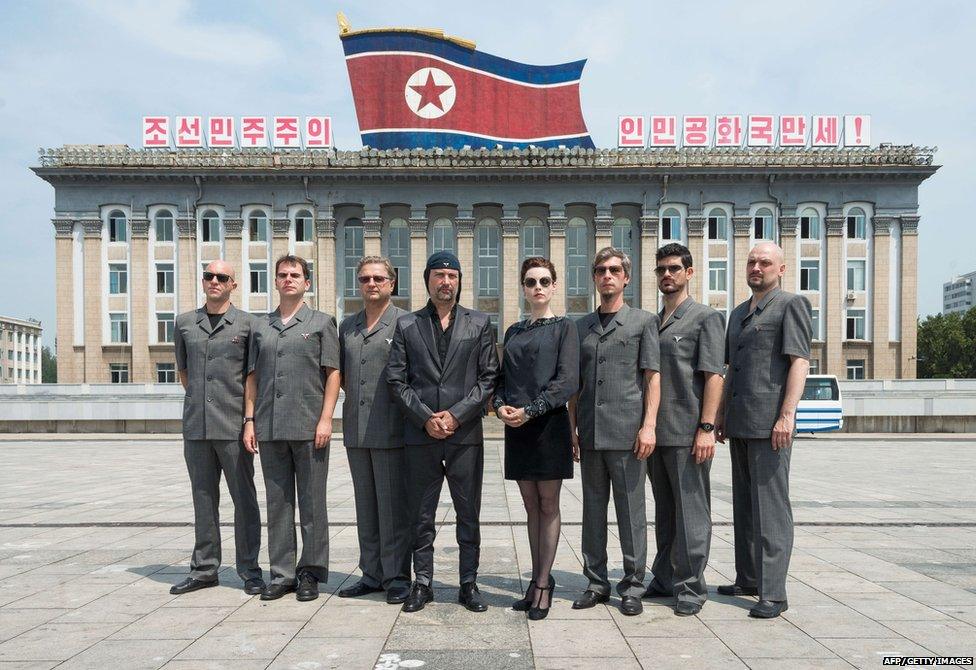
Co-Directed by Norwegian artist Morten Traavik and Uģis Olte, Liberation Day documents the unlikely 2015 concerts by Slovenian industrial art collective Laibach in Pyongyang, staged as part of the DPRK’s 70th anniversary of liberation from Japanese rule. What could have easily become a stunt or a provocation instead becomes a quietly revealing study in compromise, cultural friction, and the mechanics of getting anything done inside a highly risk-averse system.
On paper, Laibach are either completely wrong for North Korea or uniquely suited to it. Liberation Day makes a convincing case for the latter. Since forming in 1980 in then-Yugoslavia, the group has built its identity around authoritarian aesthetics, martial rhythms, and deliberate ideological ambiguity.
Their most famous works are covers that strip pop songs of sentiment and rebuild them as industrial anthems: “Opus Dei” from Opus’ “Life Is Life,” “Geburt Einer Nation” from Queen’s “One Vision,” and The Sound of Music covers reworked for North Korea. Audiences and critics have spent decades trying to pin them down. Fascists? Anti-fascists? Satirists? Laibach never clarify. Their supporters argue that this refusal is precisely what has given the project longevity, allowing it to outlast the political system that produced it.
That ambiguity is exactly why Laibach worked in the DPRK.
The concerts themselves took place at the Ponghwa Theatre in Pyongyang and featured selections from The Sound of Music, alongside Laibach originals and a Korean language rendition of the traditional song “Arirang.” The choice of The Sound of Music was not ironic trolling. The film has actually been widely screened in North Korea and reportedly appreciated for its anti-fascist themes.
But Liberation Day is not a concert film. The performances matter less than the process of making them happen.
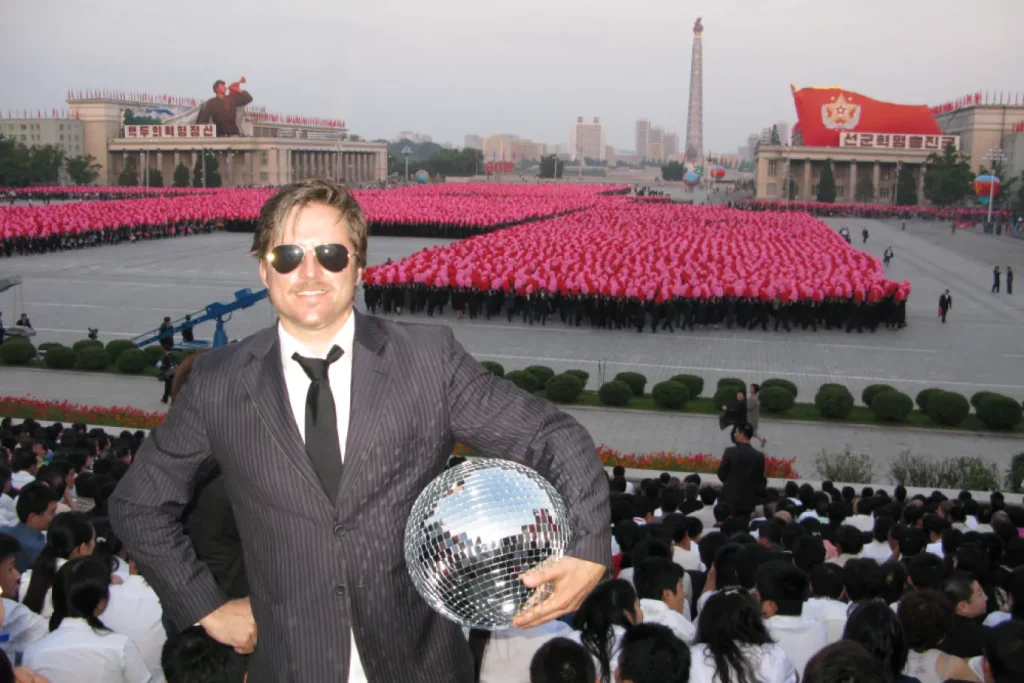
As the documentary’s director and main protagonist, as well as the concert’s co-producer, Traavik positions himself not as a hero, victim, or truth-teller, but as a mediator. This alone separates the film from most Western treatments of the DPRK. By the time of the concerts, this was his fifteenth trip to North Korea, and after multiple prior projects with the Ministry of Culture, Traavik clearly understands that performative resistance may play well back home but accomplishes little on the ground. Instead, he works within the system as it exists, not as he wishes it to be.
Upon Laibach’s arrival in Pyongyang, a representative from the DPRK Ministry of Culture voices concerns he has encountered in foreign media and internally. Essentially, “Laibach are fascists who seek to undermine the DPRK’s social system by making a mockery of it… and their music is terrible.” However, he notes that because of their previous collaborations with Traavik, the project is proceeding on mutual trust.
And remarkably, that trust holds.
The logistical miracle at the heart of Liberation Day is that the final preparations for the concerts take place over roughly two days. Every conceivable obstacle emerges, from confusion caused by language barriers and technical hiccups to plainclothes North Korean security officers hovering around the theater while the band tries to set up and rehearse. Censors review and demand to cut video projections. Lyrics translated from German into Korean are scrutinized, with sensitivity around South Korean dialect usage. In a system driven by inertia, where staying on familiar ground is safer than attempting anything new, this is extraordinary. The film captures the constant negotiations required to move even small details forward.
One conflict arrives with Laibach’s version of the then-new DPRK pop song “We Will Go to Mount Paektu.” Despite earlier positive feedback, the Ministry of Culture later informs Traavik that an internal poll has been conducted at the ministry and the verdict is unanimous: the song is not suitable for a Korean audience and must be removed from the setlist.
This is the point where most documentaries would frame the situation as censorship and collapse into outrage. Liberation Day resists that impulse. What the film actually shows is institutional self-preservation. No one wants to be responsible if the reinterpretation lands poorly. In a system where failure carries consequences, innovation becomes dangerous not because it is forbidden, but because it is risky.
Traavik handles the situation with remarkable tact. He knows when to push and when to yield. That particular song is cut, but the setlist is still locked at 11 standout songs. A compromise is reached, and the concert proceeds. The victory here isn’t ideological so much as practical, rooted in goodwill and compromise.
Interestingly, Koreans we later played the track for on YPT trips all liked it, or at least said that they did. Which only reinforces the sense that the decision had less to do with public reception than bureaucratic accountability.
The August 19, 2015 concert performance at Pyongyang’s Ponghwa theater was later released as The Sound of Music, with additional recordings and rehearsal material appearing on the Party Songs EP.
Liberation Day ultimately accomplishes a quiet dismantling of the dominant narrative surrounding North Korea. It does not claim the country is misunderstood in some grand ideological sense, nor does it pretend that art can transcend politics. Instead, it shows what happens when you approach the DPRK without fantasy, contempt, or a prewritten moral conclusion.
Liberation Day‘s greatest strength is its restraint. It does not tell you what to think. It allows events to speak for themselves. In doing so, it reveals something far more unsettling and far more useful than yet another exposé: that something meaningful can be produced through cooperation rather than confrontation.
And in a genre addicted to friction and failure, that feels genuinely radical.
Follow me on Letterboxd for reviews of DPRK cinema and films connected to North Korea.
About Post Author